Strut: AI Writing Assistant for Writers
A writer sits with scattered notes, a half-built outline, and a chapter deadline that keeps moving. Strut, a AI Writing Assistants tool, pulls those notes, sources, and the current section into one context so AI operations work from the whole project, not a blank prompt. Strut does not offer unlimited free projects.
- United States 100%
What Strut Does
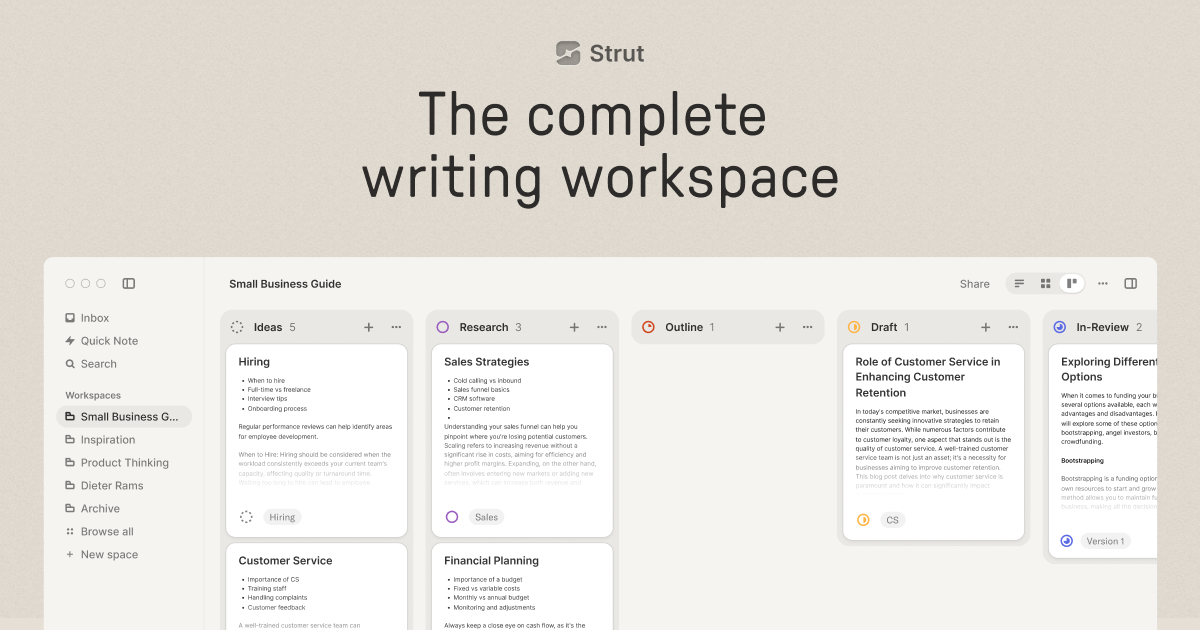
Strut organizes notes, research, and drafts into one project so long-form writing keeps its context from first fragment to finished manuscript.
Writers lose time re-explaining a story or argument every time they open a new document. Strut keeps the Writer’s Notebook, source imports, and the current draft in one project, then runs eight writing operations — expand, outline, strengthen, summarize, critique, tone, plot, rewrite — against selected passages using that stored context, with a Voice Profile carrying style across the manuscript.

Main Features
Writer’s Notebook
Strut’s Writer’s Notebook captures rough notes, voice notes, and source clips as they arrive, before any structure exists. Clips carry their origin document and page automatically, so a quote pulled today still points back to its source weeks later when the chapter gets written, and nothing has to be re-found or re-typed from memory.
Long-form Editor
The editor combines outline navigation, word goals, focus and typewriter modes, and style statistics in one writing surface. A writer can jump from a chapter outline to the paragraph being drafted without switching files, so structure and sentence-level work stay visible at the same time, and a stalled chapter can be reordered without leaving the document.
Research Notebook
Strut imports PDFs, Word files, and spreadsheets, transcribes scanned pages, and answers questions against those sources with page-level citations. The AI critique operation then flags unsupported statements in a draft, so fact-checking happens against the same material already stored in the project instead of a second research pass later.
Editing and Feedback
Reviewers can be invited into a project to leave inline comments, and writers can share frozen, password-protected snapshots with expiry dates. Feedback and version history live next to the draft itself, so a shared chapter does not drift out of sync with the working copy, and an expired link stops exposing an old draft indefinitely.
Use Cases
-
Long-form writing workspace
Writers bring scattered notes and partial drafts into a single Strut project. The Writer’s Notebook and long-form editor keep that material attached to the manuscript, so expanding a chapter does not mean losing the fragment it started from.
-
Journalists managing interview sources
Journalists import interview recordings and documents into Strut alongside a reported draft. Source imports and provenance tracking keep attributions intact while the writer drafts, and password-protected snapshots let editors review a version without touching the live file.
-
Managing scattered research and documents
Researchers import PDFs, filings, and transcripts into a centralized Strut project and query them with page citations. The Research Notebook keeps provenance attached to every clip, so a cited claim can be traced back to its exact source page.
Best For / Not For
Strut is built for people assembling long-form work from scattered raw material rather than writing a single short piece from scratch.
Writers drafting essays, reports, or manuscripts that span many sections benefit from the project structure. Journalists juggling interview recordings and source documents get provenance tracking built into the notebook. Researchers working from PDFs and transcripts can query sources with page citations instead of re-reading them.
Strut limits free accounts to one project with three documents and a lifetime cap of 50,000 AI tokens, so anyone running multiple ongoing projects without paying will hit that ceiling quickly.
Pricing
Strut’s Free plan costs nothing forever, and the Pro plan runs $69.99 per user per year billed annually, or $9.99 per month after a 7-day free trial.
| Plan | Price | Included |
|---|---|---|
| Free | Free | One project with up to three documents, unlimited notes, 50,000 lifetime starter AI tokens |
| Pro | $69.99 / user/year, billed annually | Unlimited projects and documents, 1,000,000 AI tokens every month |
The Pro trial requires a card on file and auto-renews at $9.99 per month or $69.99 per year once the 7-day trial ends unless cancelled beforehand, and downgrading afterward keeps existing projects readable but removes the monthly token allowance and unlimited project count.
Pricing checked 2026-10-25.
Quick Comparison
Book AI Writer is Strut’s main alternative for structuring and drafting long manuscripts with AI assistance. Book AI Writer focuses its tooling specifically on book-length fiction and nonfiction generation workflows. Strut instead keeps a Research Notebook with page-cited source imports and a Voice Profile that carries style across an entire project. Choose Book AI Writer if the project is a single book built mostly from AI generation. Choose Strut if the work mixes interview recordings, PDFs, and notes that need provenance tracking.
Verdict
Strut stores notes, sources, and drafts in one project and runs eight AI writing operations against selected passages, with Pro unlocking 1,000,000 tokens monthly for $69.99/year. It fits writers, journalists, and researchers managing long, source-heavy projects over a single quick draft.