
Copyleaks: AI Detection for Teachers and School Administrators
Teachers reading a stack of essays cannot tell which paragraphs a student wrote and which a chatbot generated. Copyleaks is an AI-writing and plagiarism verification platform, a AI Detection tool, that scans submitted text and flags AI-generated or copied passages. Particularly strong at explaining flagged content through AI Logic — not built for detecting plagiarism in scanned images.
- United States 35%
- India 11.2%
- Philippines 6.1%
- Italy 3.3%
- Other 44.4%
What Copyleaks Does
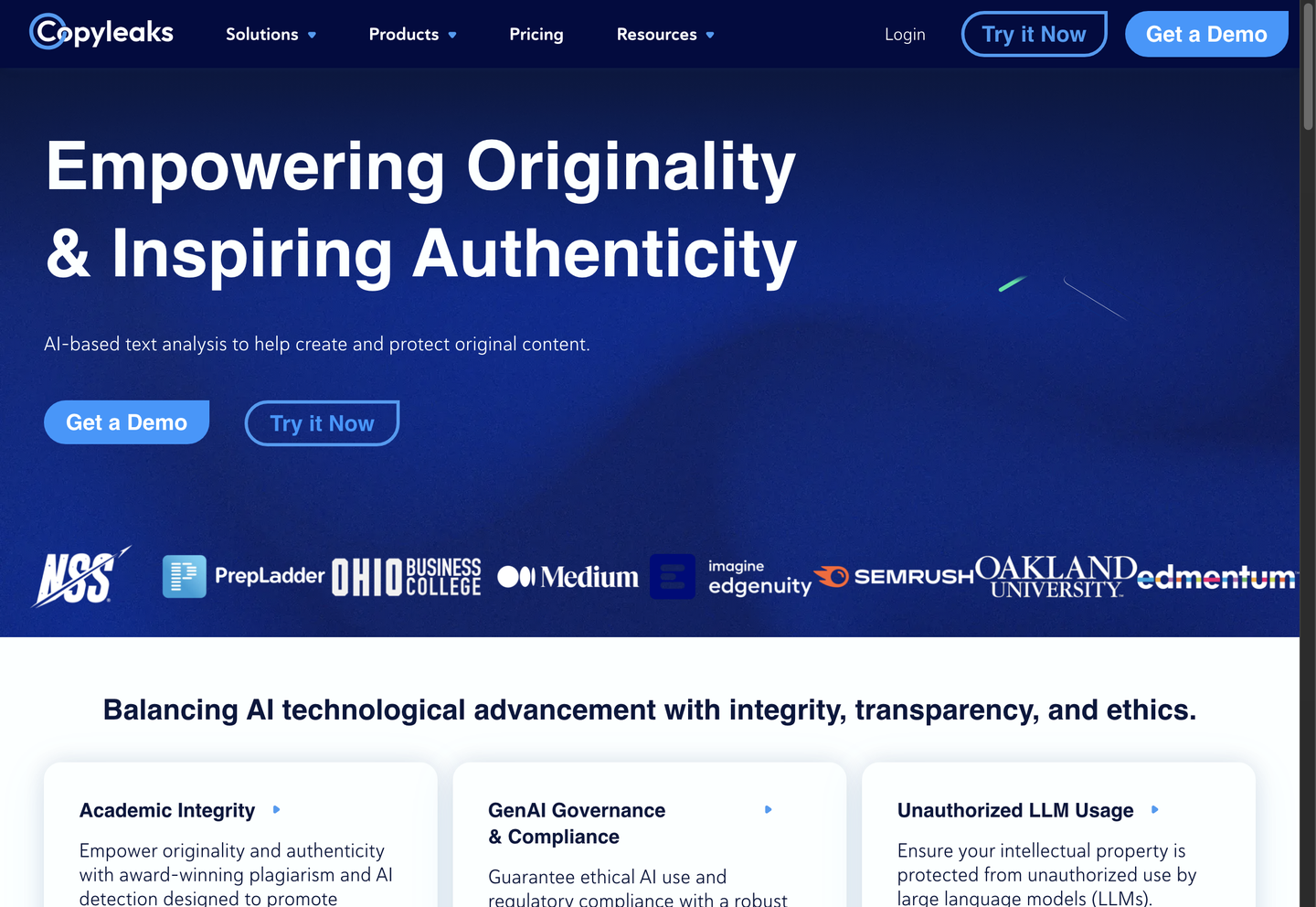
Copyleaks solves the identification gap by running submitted text through AI-detection models and a plagiarism index in one scan. It combines AI detection across 30+ languages with plagiarism checking across 100+ languages, so a single report covers both authenticity questions. Its Shared Data Hub cross-checks submissions against millions of user-submitted documents, and AI Logic names the specific phrases that triggered a flag rather than returning an unexplained score. Copyleaks also scans images for AI generation and checks source code for reuse, extending detection beyond plain text into LMS and browser workflows.
Main Features
AI Detector
Copyleaks scans text in 30+ languages and reports a probability that content is AI-generated, backed by AI Logic explanations that point to specific flagged phrases and matched sources. Because the reasoning is visible rather than a single score, teachers can review evidence with a student instead of relying on a black-box verdict alone.
Plagiarism Checker
The Plagiarism Checker matches submitted text against a database spanning 100+ languages, including cross-language translation detection that catches content translated from another source before submission. It also scans source code for reuse, so the same check covers written assignments and programming coursework without switching tools mid-review.
AI Image Detector
Copyleaks analyzes uploaded images and produces a visual report marking regions showing AI-generation signals, separate from its text-plagiarism matching. This runs as a standalone check without a plagiarism comparison for images, so it answers whether an image was generated but not whether it was copied from elsewhere.
LMS Integrations
Copyleaks connects natively to Canvas, Moodle, Blackboard, Schoology, D2L Brightspace, Sakai, and Edsby, syncing scan results and grades directly into the gradebook. Because the check runs inside the LMS an instructor already uses, submissions do not need to be exported to a separate scanning site for review.
Use Cases
-
Academic Integrity and AI Policy
Teachers and school administrators review student submissions for unauthorized AI writing and copied text. Copyleaks applies its AI Logic explanations to show exactly which phrases triggered a flag, so instructors can discuss findings with students instead of issuing an unexplained verdict.
-
AI Model Training Data
Data scientists and ML engineers scan candidate training datasets before feeding them into a model. Copyleaks flags AI-generated, duplicate, or low-quality documents, so teams filter contaminated text out of a corpus before training begins rather than discovering issues afterward.
-
Governance and Compliance
Compliance officers and enterprise teams monitor internal communications and published content for AI misuse and IP violations. Copyleaks runs its API-based detection across workflows at scale, so policy checks happen continuously instead of through manual spot audits.
Best For / Not For
Copyleaks is built for people responsible for verifying whether text was written by a person, an AI model, or copied from another source.
Teachers and School Administrators checking student submissions, Data Scientists and ML Engineers filtering training corpora, and Compliance Officers and Enterprise Teams monitoring content for policy violations are the core audiences.
Copyleaks limits its Personal plan to 1,200 unified credits per month covering roughly 300,000 words, so high-volume solo users scanning large document sets will exhaust the allowance quickly and need the Pro tier or extra credits.
Pricing
Copyleaks prices its Personal plan at $13.99 / user/month, billed annually, and its Pro plan at $74.99 / user/month, billed annually, with Enterprise and Education plans quoted separately by sales.
| Plan | Price | Included |
|---|---|---|
| Personal | $13.99 / user/month, billed annually | 1,200 unified credits, scan up to 300,000 words or 1,200 images |
| Pro | $74.99 / user/month, billed annually | 12,000 unified credits, scan up to 3,000,000 words or 12,000 images |
Neither row shows what happens once monthly credits run out, beyond the option to purchase extra credits, or the exact custom quote used for Enterprise and Education plans.
Pricing checked 2026-09-13.
Quick Comparison
Originality AI is Copyleaks’s main alternative for content-team AI and plagiarism screening. Originality AI focuses on editorial workflows for publishers and SEO teams with a browser-based plagiarism scan. Copyleaks covers a wider surface with seven LMS integrations, code scanning, and image detection alongside text. Choose Originality AI if the primary need is editorial and marketing content review. Choose Copyleaks if the workflow spans classrooms, code, and images across an institution.
Verdict
Copyleaks scans up to 300,000 words monthly on its $13.99/user/month Personal plan, pairing AI detection with plagiarism matching in one report. It suits teachers and compliance teams needing explained flags over a bare score.


