
Quilter.ai: AI PCB Design for Faster Hardware
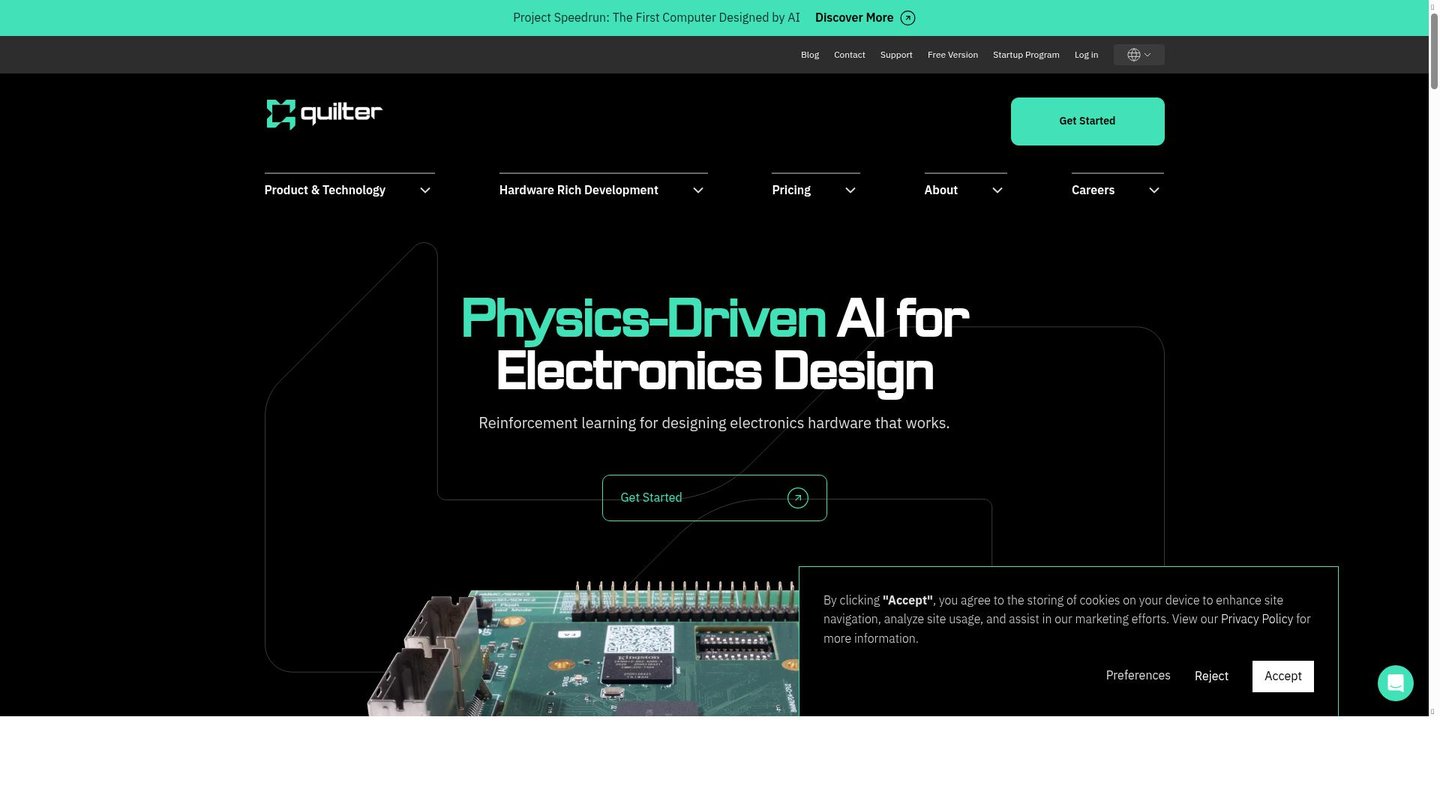
Quilter.ai is an AI-powered PCB design tool that turns complex board layouts into fabrication-ready files in hours instead of weeks. For example, a hardware startup can upload a schematic and quickly get multiple manufacturable layouts to evaluate. As a result, engineers spend less time on repetitive routing and more time refining high-speed, high-density products.
- United States 33%
- India 11.5%
- Sweden 9.4%
- New Zealand 5.2%
- Other 40.9%
About Quilter.ai
In particular, Quilter.ai is a physics-driven AI platform that automates PCB component placement, routing, and stackup exploration for professional electronics teams. It solves the bottleneck of manual layout, where engineers must route thousands of traces and respect strict manufacturing rules. Instead of drawing every connection, users submit native CAD projects and let the AI explore multiple design options.
Moreover, Quilter.ai is used by PCB designers in consumer electronics, aerospace, and automotive companies who need reliable layouts on aggressive schedules. A senior hardware engineer can, for example, upload an Altium or Cadence project and receive several fully routed candidates that meet signal integrity and DFM constraints. Then the engineer simply reviews, polishes, and generates fab files in the tools they already know.
As a result, the platform enables real-world use cases such as validation boards for new silicon, where verification teams must spin new designs every few weeks, and compact IoT devices, where layout specialists must fit dense components into tight form factors. Behind the scenes, Quilter.ai uses reinforcement learning and built-in electrical and physical models to test each candidate, ensuring manufacturable layouts that still respect design rules and performance targets.

Features of Quilter.ai
Consequently, the features in Quilter.ai focus on making advanced PCB layout fast, consistent, and scalable across teams.
- Autonomous PCB Layout: Automates component placement and routing, delivering complete boards for AI content creation workflows that depend on reliable, manufacturable electronics.
- Physics-Driven Design Engine: Uses reinforcement learning and physical modeling to evaluate trace geometry, stackups, and constraints, much like an AI video maker optimizes frames for quality.
- Native CAD Integrations: Works with Altium, Cadence, Siemens, and KiCad projects, preserving existing libraries and flows inside your preferred digital storytelling tool stack.
- Massive Design Space Exploration: Generates many layout candidates in parallel, allowing engineers to compare cost, layer count, and signal integrity without manual rerouting.
- Deterministic, Fabrication-Ready Output: Returns layouts in the same native formats, so teams can run DRC, add copper pours, and export Gerber files inside their current video generation platform of documentation.
- Transparent Design Review: Highlights critical nets, differential pairs, and bypass capacitors so reviewers see how the AI met constraints before signing off.
- High-Speed and Dense PCB Support: Optimizes for impedance, via strategies, and layer usage, making automated animation of complex design iterations practical in tight schedules.
- Scalable Workflow for Teams: Allows multiple engineers to submit and review jobs concurrently, supporting continuous hardware iterations across global teams.
Furthermore, Quilter.ai extends beyond core layout automation with options that fit different business sizes and workflows. The platform provides a free tier with unlimited design iterations for small teams, so startups can experiment with advanced automation without large upfront costs. In addition, larger organizations can access dedicated deployments with team management, custom integrations, and enterprise-grade security, including private cloud or on-premise hosting. Because of these options, companies can integrate Quilter.ai into existing CI-style hardware flows, triggering layout jobs from design milestones. The result is a more agile product pipeline where each engineer can complete many more design cycles each year, while still protecting sensitive IP.
Ultimately, Quilter.ai gives PCB designers a practical way to turn layout from a slow, manual task into an automated, guided process powered by an AI content creation engine for hardware. As a result, teams that adopt this digital storytelling tool for electronics can explore more ideas, reduce risk in high-speed designs, and hit market windows with confident, fabrication-ready boards.


