
Mubert: AI Music Generators for Individual Creators
Mubert works as a AI Music Generators for individual creators, generating royalty-free tracks from text, mood or image prompts. Individual creators use Mubert to generate music for videos, podcasts or ads before publishing deadlines. Mubert handles short-form background tracks well, while licensing music for Spotify or YouTube Content ID still needs a traditional distributor.
- United States 11.3%
- India 7.3%
- Brazil 5.9%
- Russia 4.1%
- Other 71.3%
What Mubert Does
Mubert generates royalty-free music from text prompts, images or mood selections, producing a finished track in seconds.
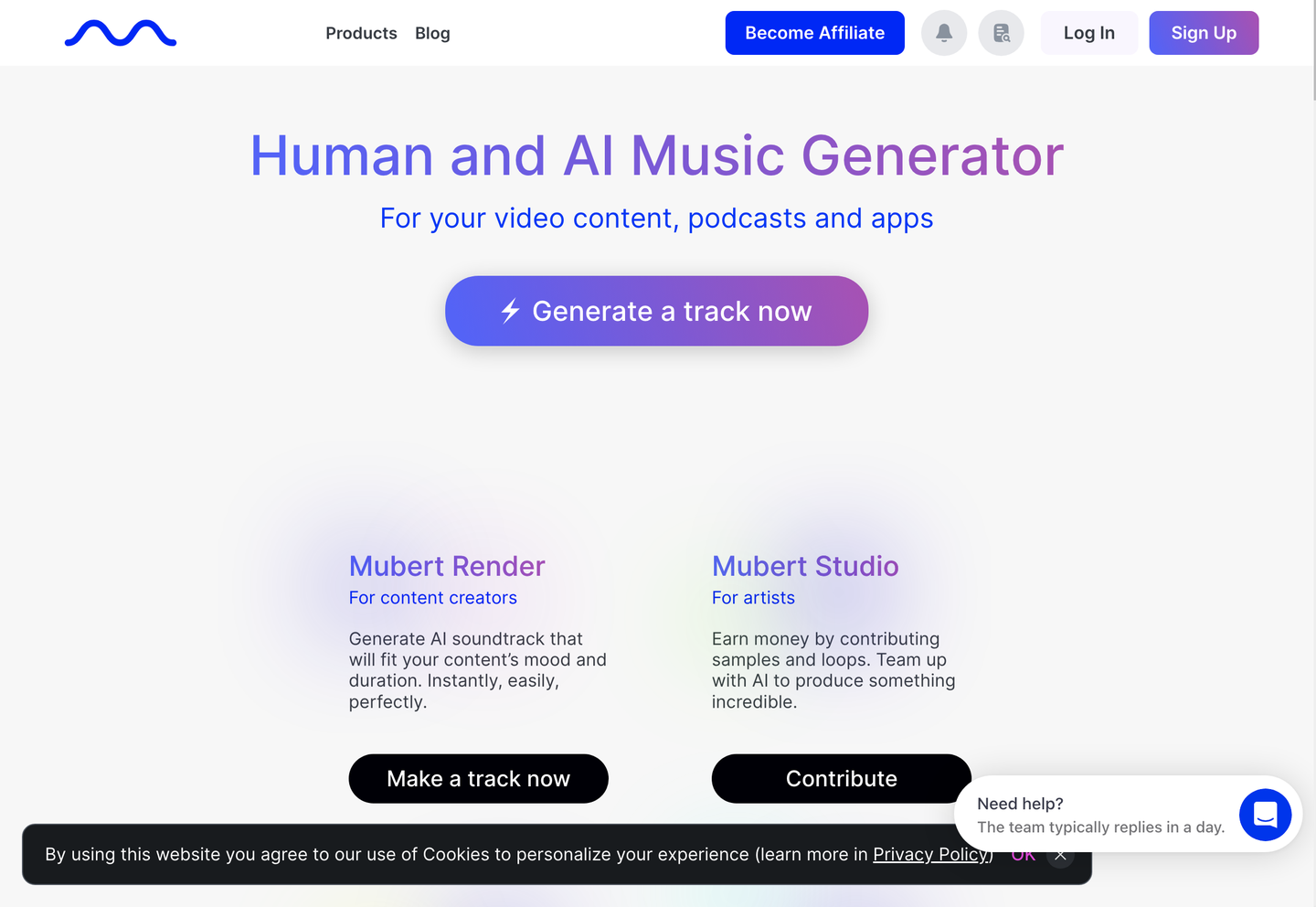
Mubert pulls from a library built on samples and loops from hundreds of artists to assemble tracks that match a stated mood, genre or BPM, rather than looping pre-recorded stock clips. Four product lines split the workflow: Mubert Render for one-off content soundtracks, Mubert Studio for artists contributing source material, Mubert API for developers embedding generation into apps, and Mubert Play for listening to the output. Track length can run from fixed short clips to extended durations depending on plan.
Paid tiers add stem editing and full track restructuring, so a generated track can be adjusted without starting a new prompt from scratch.
Main Features
Mubert Render: For content creators
Mubert Render generates a soundtrack matched to a stated duration and mood directly from a text prompt or brief description. The output arrives as a finished render rather than a loopable loop segment, so creators can drop a track into a video timeline without trimming or re-syncing to picture.
Mubert Studio: For artists
Mubert Studio lets musicians contribute samples and loops that feed the generation engine, earning payment when their material is used. This turns Mubert’s catalog into a continuously supplied library rather than a fixed stock set, which means the available moods and genres expand over time instead of staying static.
Mubert API: For developers and brands
The Mubert API exposes generation, streaming and library functions so developers can call music creation directly from an app, game or product. Fast generation and commercial licensing are included at the API tier, which means music can be requested programmatically instead of pre-rendered and stored as static audio files.
Mubert Play: For listeners
Mubert Play streams generated tunes suited to a given moment or activity, pulling from the same underlying catalog as Render and the API. Because it draws on the same generation system, the listening experience reflects whatever moods and genres the artist-contributed library currently supports, rather than a fixed playlist.
Use Cases
-
Generate music for videos
Individual creators bring a video, podcast or ad that needs a soundtrack. Mubert Render generates a track matched to the content’s mood and duration from a text prompt. Creators get a usable score without searching stock libraries for a length-matched clip.
-
Background music for podcasts
Individual creators producing a podcast need consistent background sound across episodes. Mubert’s mood and genre controls let them pick a tone once and regenerate variations for new episodes. This keeps a show’s audio identity consistent without hiring a composer per episode.
-
Music for indie games
Game developers with limited budgets need multiple tracks without commissioning a composer for each scene. The Mubert API generates music programmatically at commercial licensing tiers. Developers add adaptive soundtracks to a game without a per-track licensing negotiation.
Best For / Not For
Mubert is built for people who need background or soundtrack music on a recurring basis rather than a single polished composition.
Individual Creators producing videos and podcasts, Game Developers needing adaptive in-game audio, and Agencies & Brands scoring digital ad campaigns are the core audiences named on Mubert’s own pages.
Mubert is not built for anyone who needs to publish tracks to Spotify, Apple Music or YouTube Content ID: the platform’s own terms state tracks cannot be sold, distributed on streaming platforms, or registered in Content ID systems.
Pricing
Mubert’s Ambassador plan is free with 25 tracks per month, while the first paid tier, Creator, costs $11.69 per user/month billed annually for 500 tracks and unlimited downloads.
| Plan | Price | Included |
|---|---|---|
| Ambassador | Free | 25 tracks / month, 5 downloads per month |
| Creator | $11.69 / user/month, billed annually | 500 tracks / month, Unlimited downloads |
| Pro | $32.49 / user/month, billed annually | 500 tracks / month, Unlimited downloads |
| Business | $149.29 / user/month, billed annually | 1,000 tracks / month, Unlimited downloads |
Monthly billing runs higher than the annual rates shown here, and Mubert states all payments are non-refundable regardless of plan.
Pricing checked 2026-10-25.
Quick Comparison
MuseGen is Mubert’s main alternative for prompt-driven instrumental generation workflows. MuseGen focuses on a streamlined prompt-to-track pipeline aimed at quick single-track output. Mubert instead offers four distinct products, Render, Studio, API and Play, covering content creation, source contribution and app integration in one system. Choose MuseGen if a single quick track from a prompt is all that’s needed. Choose Mubert if the project requires an API, exact-duration render, or an ongoing library of contributed samples.
Verdict
Mubert generates up to 1,000 tracks per month on its Business plan at $149.29/month, giving agencies and developers programmatic access to royalty-free audio. Individual creators and indie game developers get a lower-cost path through the $11.69 Creator tier. It fits recurring content needs better than one-off music licensing.