Anthropic's own data shows junior technical hiring falling from 27% to 9% while AI agents log six times their handlers' hours. Named researchers question what one AI company's numbers say about the job market.
Only 9% of Anthropic’s new technical hires are junior, down from 27% in early 2025, according to a report the company published on October 16, 2026. By August, the AI agents its employees direct were logging six times as many hours as the employees themselves. Researchers outside the company doubt that one AI firm’s internal numbers say much about the wider job market.
Report and sources checked on October 24, 2026.
What Anthropic’s report shows
Four Anthropic economists built the study on internal records covering employment, AI use, output, surveys, calendars and hiring decisions, plus 17 employee interviews. Because the company has rebuilt so many workflows around AI, they present it as a possible leading indicator for the rest of the economy.
Junior roles shrank on all three measures in the first chart. In technical departments, juniors made up 21% of staff in early 2025 and 14% by mid 2026. Their share of new technical hires fell faster, from 27% to 9%, and just 6% of open technical roles are junior positions. Postings dropped most sharply after December 2025.
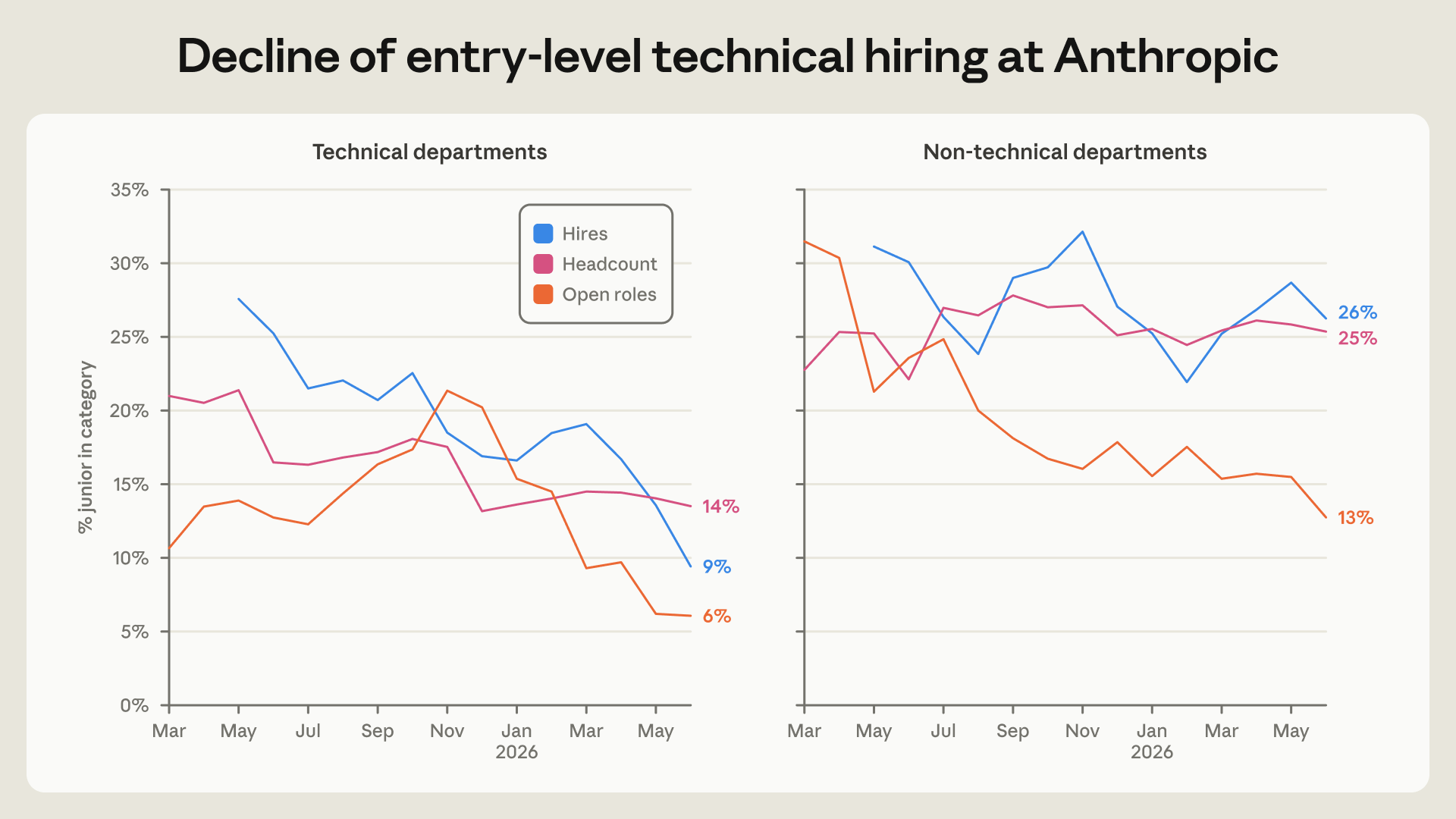
All of these figures are shares of a growing workforce. In absolute numbers, technical hiring at Anthropic is still growing. Sales, finance and recruiting grew faster, which pulled technical departments from 61% to 56% of the workforce. In non-technical departments juniors still account for 26% of hires and 25% of staff.
The report names a second reason for the shrinking technical share. People outside engineering now write software themselves. Among non-technical employees with no code commits at the start, coding sessions with agents rose from 2 a month in August 2025 to 90 in May 2026. One sales representative built a custom dashboard and pipeline in three to four hours, a project they said had been out of their league.
Agents now log six times their handlers’ hours
The second chart shows where the work went. Anthropic counted the time employee-directed agents actually run, including model computation and tool use but no waits over 30 minutes, and set that against a 40-hour week per employee. Research teams reached one agent hour per human hour in April, and the company as a whole followed in May. By August, agents logged six times the hours of the people steering them, and 19 times in research organizations. With fully autonomous agents included, agent hours passed human hours as early as March 2026.

Output rose with it. Code commits per engineer are five times what they were six months earlier, and engineers delete or revert agent-written code no more often than code they wrote by hand. Human attention is where the system strains. Interactive Claude sessions spend about 80% of their time waiting for a person. Even in non-technical teams, reading everything the agents produce would fill more than half the work week. One engineer told the authors about facing “an army of Claudes, with every one asking for my attention.”
Employees answer with more work about agents. Writing specs, having one agent review another and monitoring pipelines grew from 10% of the average employee’s Claude sessions in fall 2025 to 22% in spring 2026.
Time with colleagues went up as well. The median employee spends 20% more time in meetings than a year ago. Company growth and more meeting-heavy business roles explain part of that, but technical individual contributors also meet 16% more. In interview after interview, employees described face-to-face coordination as indispensable.
What hiring managers look for now
The shift started in the teams that relied most on Claude for writing code and finding bugs. Talk of lower demand for junior technical staff began in January 2026, and by April engineering and research teams had deprioritized lower-level positions. In a survey that month, about a third of machine learning managers and a fifth of software engineering managers said they hire fewer people because of AI.
Interview scorecards show what Anthropic looks for instead. Anthropic coded the notes on thousands of candidates hired since 2024. Remarks on a candidate’s record with AI tools tripled for technical roles and quadrupled for non-technical ones. For technical candidates, comments on autonomy and judgment grew the most, and domain expertise took up a smaller part of the assessment.
Why researchers doubt the findings
Several academics told the Guardian that they read the report as an attempt to lift Anthropic’s valuation before its stock market debut, which could come as soon as November. Julián Posada, a social scientist at Yale, said the report “is written from the perspective of a company that wants to sell shares.” He added that, unlike an economics study, it had no independent assessment by outside auditors.
Morgan Frank of Case Western Reserve University pointed to his paper, now in peer review, which finds that job markets exposed to AI were already worsening before ChatGPT launched in November 2022. He also named cuts to pandemic-era hiring and “AI-washing”, where executives credit AI for layoffs they might have made anyway.
Dylan Baker, lead research engineer at the Distributed AI Research Institute, called hiring few juniors while the remaining engineers wrangle agents “shortsighted.” Baker also rejected the bottleneck framing, saying it misreads “how software is written, architected and designed.”
The same article recalls that Anthropic CEO Dario Amodei warned in 2025 that AI could eliminate half of all entry-level white-collar jobs, a forecast the paper says has not come true. Anthropic did not respond to its request for comment.
What it means for entry-level tech jobs
The data comes from a company that sells AI agents and has rebuilt its own work around them. Its case that AI drove the hiring shift rests on manager surveys, interviews, timing and a correlation between shrinking junior headcount and complex Claude use in the same jobs. Whether other employers will follow is a hypothesis that numbers from a single firm cannot test. Anthropic is setting up an early warning system for jobs at risk and moves affected staff into new roles. The authors concede that none of this helps people who are never hired.
For graduates, the scorecard data is the most useful part. Interviewers at Anthropic now comment far more often on how candidates use AI tools and on their autonomy and judgment, and less on narrow domain skills. Projects that show you can direct agents and judge their output speak to exactly those criteria.
