Goldman Sachs has limited Claude Code and GitHub to its engineers, months after its CIO praised vibe coding by traders and bankers. The bank names no incident and no numbers.
Goldman Sachs has barred most of its staff from advanced AI coding tools, keeping Claude Code and Microsoft’s GitHub for its 12,000 engineers, Bloomberg News reported on November 2, 2026, citing internal guidance updated in October. Traders and bankers had used the tools for months, and in July the bank’s chief information officer was still praising what they built. Goldman has published no findings from its review, so outsiders cannot yet tell whether the experiment failed or simply ran its course.
Report and sources checked on November 4, 2026.
What Goldman changed in October
Claude Code is Anthropic’s coding agent, which reads a codebase, edits files and runs commands. The guidance reserves it and GitHub for engineers. A second person told Bloomberg that strats, whose jobs combine trading, quantitative research and software engineering, keep access too. With more than 12,000 developers among roughly 47,000 employees, as The Next Web reported in October, engineers make up about a quarter of the firm.

According to one person familiar with the matter, some traders are frustrated because they had used the tools to watch client trading flows, model market moves and positions, and produce text and graphics.
Spokesperson Nick Carcaterra told Bloomberg that the bank weighs “a variety of factors including productivity and risk management” during a trial period, then gives tools to the people best placed to use them long term. PYMNTS points out that the bank has disclosed neither a security incident nor any productivity figures.
From praising vibe coding to engineers only
At the RAISE Summit in Paris on July 9, Bloomberg’s Tom Mackenzie put a scenario to CIO Marco Argenti, in which a trader or someone in asset management vibe codes an idea first, meaning they tell an AI what they want and let it build the thing. Argenti agreed. A prototype shows how the tool should look and feel, he said, and an engineer then builds it for production. The prototypes themselves do not go live, he added.
That account leaves a gap. Argenti described prototypes that stop short of production, while Bloomberg’s source describes traders using the tools in their work on client flows and positions. State of AI names the risk, which is a script that ends up in daily use without the review and testing an engineer’s code passes through. Nothing in the reporting says this happened at Goldman.
Other AI work at the bank continues. It has its own assistant combining models from OpenAI, Anthropic and Alphabet, and Argenti told CNBC in February that embedded Anthropic engineers had spent six months helping build agents for trade accounting and client onboarding. The bank is also a lead underwriter on Anthropic’s IPO. Its one earlier pullback in Bloomberg’s report was geographic, when staff in Hong Kong were restricted from using Claude this year.
How other banks handle the same tools
| Bank | Who gets what | Control it names |
|---|---|---|
| Goldman Sachs | Claude Code and GitHub for engineers and strats | Internal guidance, not public |
| BNY | Any employee can build on its Eliza platform, and most builders sit outside engineering | Platform built to the bank’s data, risk, legal and compliance standards |
| MUFG | Built its own version of Claude Code | All AI tools keep a human in the loop, says Stu Taylor, head of global markets AI outside Japan |
| Deutsche Bank | Developers have access to GitHub Copilot and Gemini Code Assist | No AI-generated code deploys without review, and developers answer for every line |
| ING | Vibe codes electronic trading tools such as pricing dashboards | Senior developers review the output, according to Crypto Briefing |
WatersTechnology reported in July that MUFG built its version because Claude Code was so good at reaching information that it got around security and compliance rules.
The objections so far
In Bloomberg’s report, no Goldman employee objects on the record. Frustration among traders reaches the public through one anonymous source.
State of AI’s editors think Goldman was right to restrict the tools and wrong in how it did so. Unreviewed code on a trading floor and the walls banks must keep between deal teams and traders justify the rule, they argue. A guideline update with no replacement named in Bloomberg’s report, however, tells the traders who found good uses that they were the risk. They also note that Goldman’s bankers will soon market shares in a company whose coding agent most of them may no longer use.
PYMNTS reads the move more narrowly. In its view, it does not show that employee-built applications failed, and banks are now arguing over permissions and accountability for AI-written code.
A warning from inside Goldman comes from another direction. In an August podcast, partner Chris Churchman, who co-chairs its Global Banking and Markets AI working group, said bankers risk “cognitive atrophy” if they hand their reasoning to models, CNBC reported. His remarks were about AI in general, and Bloomberg does not connect them to the October guidance.
What it means for teams using AI coding tools
We would not treat this as proof that vibe coding fails. Bloomberg’s report contains no incident, no productivity figure and no finding against the tools, and ING builds trading tools this way under senior review. The lesson we take is about order. Before licenses go out, a company should decide which data a coding agent may reach, who reviews what it produces and who owns a tool once colleagues depend on it. Goldman is settling those questions after its traders had built the tools into their work.
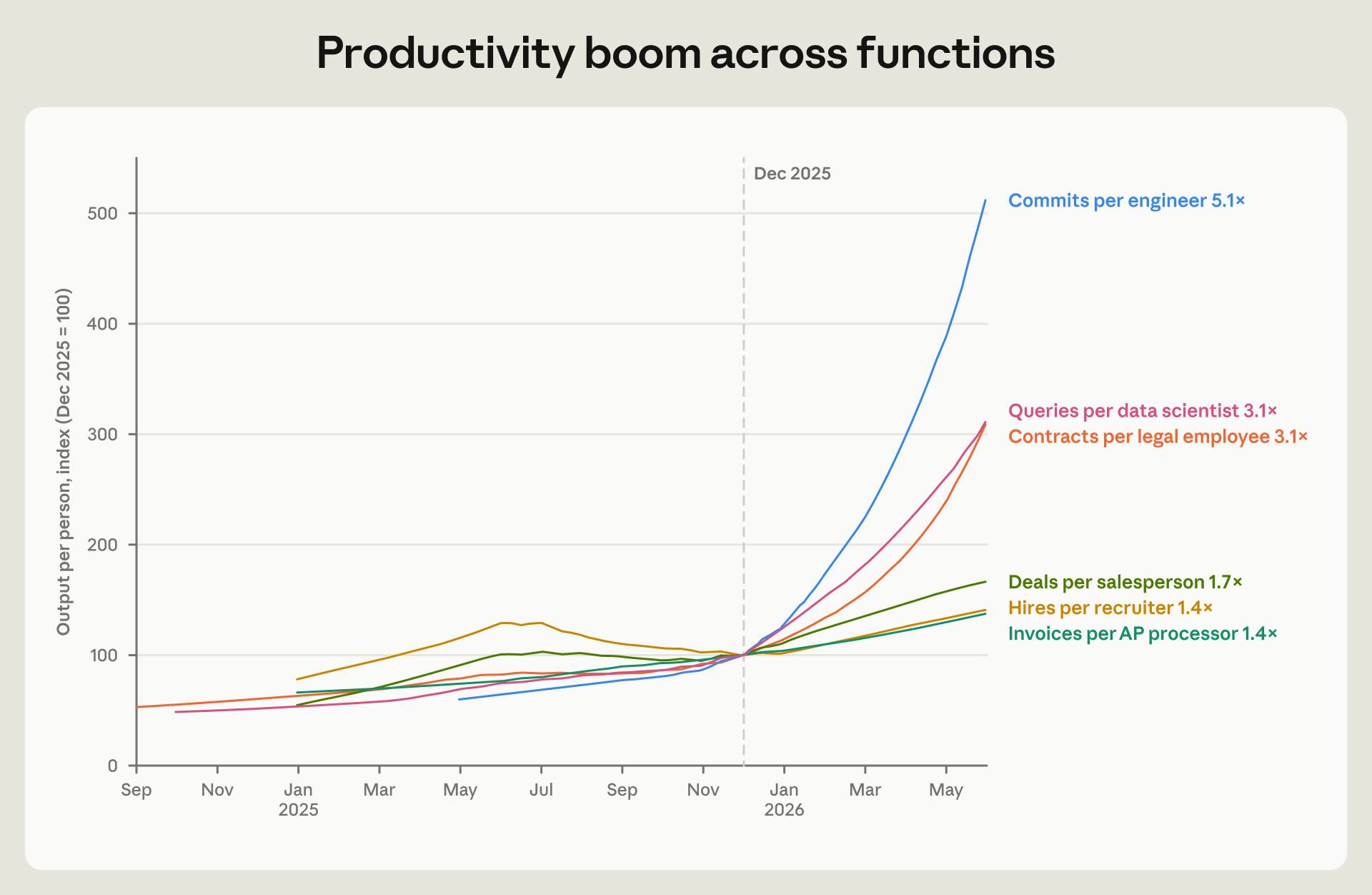
One public data set comes from the tool’s maker. Anthropic’s October report on its own staff shows output per person from December 2025 to mid 2026 up 5.1 times for commits per engineer, 3.1 times for contracts per legal employee and 1.7 times for deals per salesperson. Engineers gain most there, which would fit Goldman’s choice if it held on a trading desk. The measures differ by function, and Anthropic sells the tool it is measuring.
State of AI’s advice is practical. Name an engineer as owner of any tool built outside engineering, apply existing data and approval rules to code an agent wrote, and record what people used a tool for when access ends. Traders at the bank still need to watch client flows and model positions, with or without Claude Code.
Most companies do not need a rule this strict, in our view, because few have to keep information barriers between deal teams and traders. BNY, which counts more than 400 AI solutions in production, lets non-engineers build on a platform that carries the controls. A team without such a platform is closer to Goldman’s position, and should limit what the agent can reach before it widens who may use it.
This story rests on one Bloomberg report, anonymous sources and a document that is not public. Goldman has not said how many people lost access or what its review measured. What we know about BNY, Deutsche Bank, MUFG and ING comes from the banks or their executives.
