Four robot ducks closed Jensen Huang's GTC Berlin keynote. What Pollen Robotics' $399 Microduck can do, how owners retrain it, and why new orders now ship in four to six months.
The four robot ducks that closed Jensen Huang’s GTC Berlin keynote on October 21 are Microduck, a $399 robot with open-source software made by Pollen Robotics, the robotics team of Hugging Face. Out of the box it walks, sits, kicks, scoops small objects with its beak and gets back up after a fall, and owners can teach it new moves in simulation. The demo also sold robots. Hugging Face CEO Clément Delangue counted more than 15,000 sold by the day of the keynote and expected over 20,000 preorders a day later. Anyone ordering now should expect to wait four to six months.
Product details and sources checked on October 24, 2026.
The keynote moment
Huang ended his keynote with the ducks lined up in front of him. He asked them to sit, then to stand. When he told them to take a nap, three dropped to the floor at once while the fourth walked a few more steps before lying down, TechEBlog reported. Asked for a somersault, a couple of them managed the roll. One wandered off, tripped and got back up on its own, and Huang called it over with “Pay attention. Stay focused. Come here.”
When @jensenhuang asks for a somersault, you deliver. See how AI agents on NVIDIA RTX Spark help bring @huggingface’s Microduck from simulation to the real world.
NVIDIA RTX Spark (@NVIDIARTXSpark) October 21, 2026
Huang used the demo to make a point about his own hardware. He told the audience that the robots had been trained in the cloud on large Nvidia systems and refined in an Omniverse digital twin running on an RTX Spark machine.
What $399 buys
Microduck is a biped 25 centimeters tall that weighs 800 grams. Fifteen motors drive it. A camera, a LiDAR sensor and two inertial measurement units feed its control policy, which runs on board 50 times a second. Seven trained moves come in the box. Among them, the robot walks at the speed you command, sits down and stands back up, kicks, dips its beak to scoop something off the floor, roller-skates once the skates are fitted, and rights itself when it lands on its back.
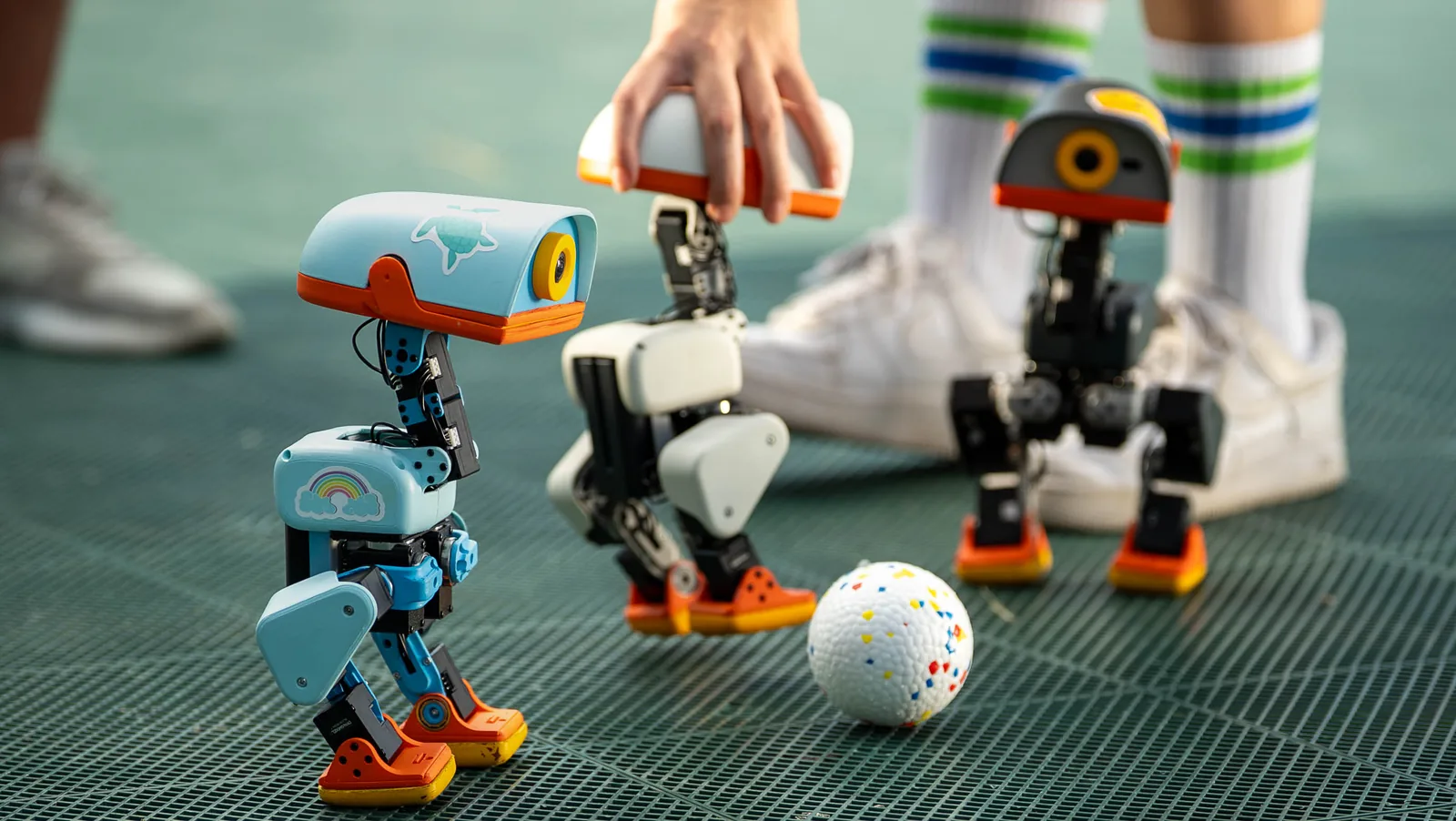
In the box are the robot, a battery, a USB-C cable and a game controller, and the shell comes in four colors. Pollen sells three add-ons. The charger pack ($39) has a dual charger and two batteries, the accessory pack ($39) adds a laser pointer, a ball, rollers and NFC tags, and the dev pack ($119) bundles three spare motors, cables, batteries, a charger and Hugging Face credit. Pollen calls the $399 an introductory price, before taxes and shipping.
Yours to retrain
What separates Microduck from a robot toy is the software. Pollen has published the SDK, the simulation and the full reinforcement learning stack on GitHub under the Apache 2.0 license, along with all seven policies the robot ships with. You train a new behavior in the MuJoCo physics simulator, on your own computer or on Hugging Face Jobs, and deploy it to the robot in one step. A behavior that works can be published for other owners. In the browser, the digital twin runs as a Hugging Face Space, so you can try the simulation before the robot arrives.
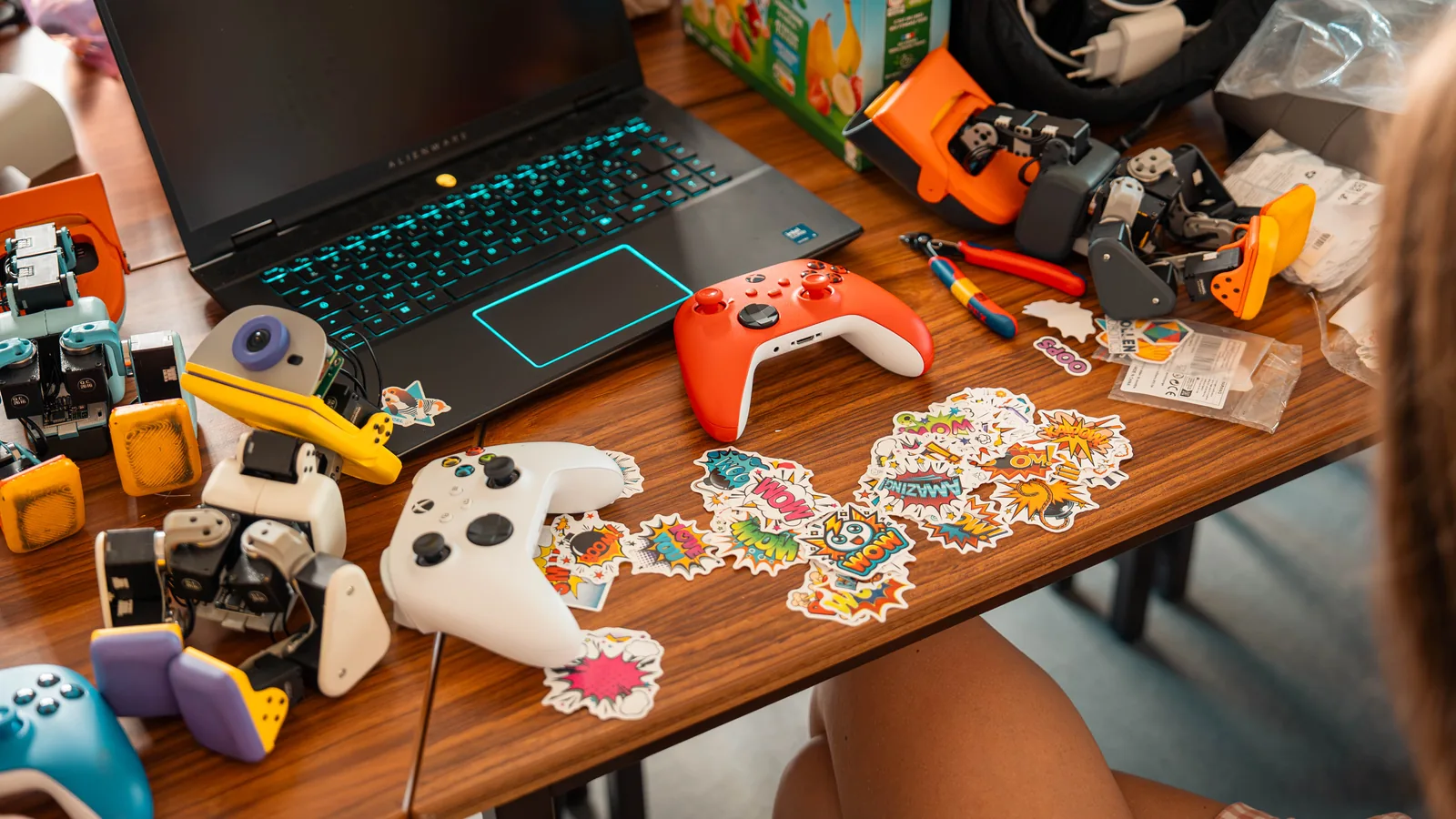
For the keynote, Nvidia used its own tools. In a short video released the same day, an AI agent called Astra builds the assets and the training course in Isaac Sim with FreeCAD and Blender. Isaac Lab then trains the duck to find its way around obstacles, and after the training run in the cloud the policy is checked in simulation on RTX Spark before it moves to the real robot.
The numbers behind the hype
Delangue posts the sales figures himself. On the day of the keynote he wrote that more than 15,000 Microducks had been sold worldwide, and that the robot was designed in Bordeaux and built with Chinese manufacturing. A day later he predicted that preorders would pass 20,000 “probably tomorrow”. TechCrunch reported the 20,000 mark as reached. Delangue’s post was a forecast, and we found no later post from him with a confirmed figure.
Demand has outrun production. On October 23 Delangue wrote that Pollen and Hugging Face need new people “in all functions”. Pollen’s store page now says it can no longer promise Christmas delivery for new orders and estimates four to six months, shipped in the order of purchase.
The same TechCrunch story calls Pollen an Nvidia company. That deal has not closed yet. Nvidia agreed on September 2 to buy Hugging Face for about $11.9 billion plus a retention program of up to $1.0 billion for employees, according to its SEC filing, and expects to complete it in the first half of 2027 if regulators approve.
Who should order one
Pollen builds its robots for AI builders and makers, and Microduck fits that description better than the “hottest toy for Christmas” framing in the headlines. For $399 you get a working biped and the complete training stack behind it, which makes it an affordable way to learn reinforcement learning and the step from simulation to real hardware. Students and developers who want to train their own policies will get the most out of it.
As a holiday gift it is a harder sell this year. New orders will not arrive before Christmas, the price excludes taxes and shipping, and anyone who plans to tinker will probably want the $119 dev pack with its spare motors. For a robot to experiment with in early 2027, the wait is the main cost of ordering now.
