
Yila for Researchers: AI Literature Review Tool
Most Knowledge Management tools organize notes a user already has; Yila searches OpenAlex, PubMed and arXiv, then reads and cites papers itself. Researchers get a source-grounded draft instead of a results list, so Yila fits review and analysis stages, not note storage. Built for academic work — teams needing broad business research will hit its limit.
- United States 50.3%
- India 25.7%
- China 14.8%
- Italy 3.4%
- Other 5.9%
What Yila Does
Researchers, Educators and Data Analysts use Yila to move a research question through literature search, reading and analysis to a drafted output, directly from a topic or an uploaded dataset.
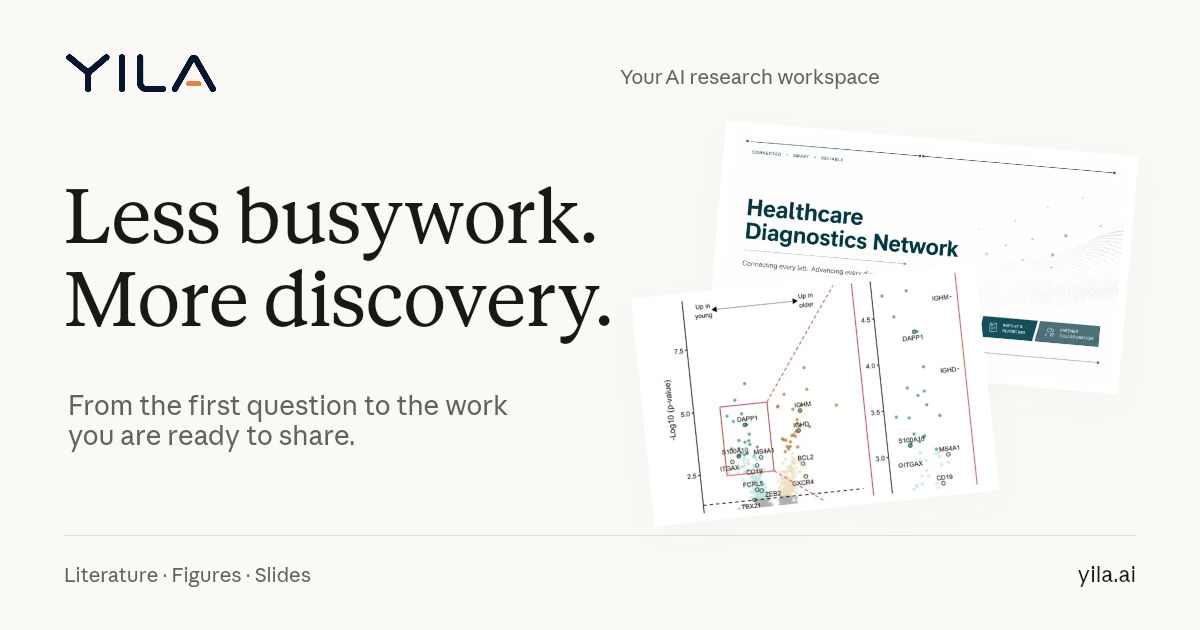
Yila runs agents for distinct research stages: checking whether a topic is open, searching databases, triaging papers, and reading 50+ papers to draft a citation-backed review. On the analysis side it turns a question into an executable plan, profiles datasets, and writes statistical results. Outputs include annotated PDFs, evidence matrices, posters and editable slides. Agents chain within one conversation, so a search feeds into an evidence matrix without re-uploading papers.
Main Features
Literature Review
Reads 50+ full papers on a topic and drafts a review with source-linked citations. Yila retrieves candidates, screens them through Paper Triage, then synthesizes findings into a thematic draft. Because citations point back to source papers, a researcher can verify claims against the original text instead of re-searching from scratch.
Evidence Matrix
Compares extracted evidence across multiple papers in a structured table rather than a linear summary. Each paper is first processed into a Paper Evidence Card, then aligned against others on shared variables. This makes contradictions and gaps between studies visible without rereading every paper side by side.
Research Gap Check
Tests whether a proposed topic is open and feasible before a researcher commits time to it. Yila scans existing literature for prior coverage and reports back on saturation. A negative result at this stage means a redirection happens before a full literature search or review draft is written.
Journal Polish
Polishes manuscript prose for a target journal’s expected register without altering the underlying scientific meaning. Yila applies this at the writing stage, after Section Writing has produced a draft from results and notes. Typesetting then auto-formats the polished text to journal-specific templates.
Use Cases
-
From paper search to a source-grounded review
Researchers starting from a bare topic use Yila’s Literature Search and Paper Triage to narrow candidates, then build an Evidence Matrix. The result is a synthesis grounded in screened sources, not a manual skim of search hits.
-
A review draft from 50+ full papers
Researchers with a defined topic use Yila’s Literature Review agent to retrieve, read and compare evidence across 50+ papers. The agent writes a citation-backed draft, so editing starts from existing structure, not blank notes.
-
Clinical analysis from a spreadsheet
Data Analysts upload a clinical dataset and use Yila’s Data Analysis and Data Exploration agents to profile it and run comparisons. Output includes charts and reusable scripts, rerunnable on updated data.
Best For / Not For
Yila is built for people running structured academic research work end-to-end, from checking whether a topic is worth pursuing through drafting and polishing a manuscript section.
Researchers drafting literature reviews or building evidence matrices across dozens of papers, Educators turning a single course topic into a full lecture deck, and Data Analysts running statistical analysis on uploaded spreadsheets are the named audiences Yila documents.
Yila publishes no enterprise customer list, security certifications, or team-collaboration tools, so organizations needing mature enterprise administration, audit trails, or general business research outside academic workflows should look elsewhere.
Pricing
Yila’s Starter plan costs $20 per user/month, billed monthly, for 10,000 credits per period, with Pro at $49/month and Flagship at $99/month for higher credit allotments.
| Plan | Price | Included |
|---|---|---|
| Starter | $20 / user/month, billed monthly | 10,000 credits per period |
| Pro | $49 / user/month, billed monthly | 30,000 credits per period |
| Flagship | $99 / user/month, billed monthly | 60,000 credits per period |
| Starter | $192 / user/year, billed annually | 120,000 credits per year |
| Pro | $470 / user/year, billed annually | 360,000 credits per year |
| Flagship | $950 / user/year, billed annually | 720,000 credits per year |
The table does not show what happens when monthly credits run out mid-period or whether unused credits roll over; verify this before committing to a tier.
Pricing checked 2026-11-06.
Quick Comparison
NotebookLM is Yila’s main alternative for turning uploaded source documents into grounded notes and summaries. NotebookLM grounds answers in a user’s own uploaded files, including audio-overview generation from source notes. Yila instead searches external academic databases like OpenAlex and PubMed itself and drafts a Literature Review from 50+ retrieved papers. Choose NotebookLM if the work starts from documents already in hand. Choose Yila if the work starts from a research question with no papers collected yet.
Verdict
Yila processes 50+ full papers into a citation-backed Literature Review draft for researchers, starting at $20 per user/month for 10,000 credits. It fits academic literature and data-analysis workflows rather than broad business research. Educators and Data Analysts get dedicated agents too.