AI Essay Writing for Students with Textero
A student facing a Friday essay deadline needs a structured draft with citations built from course materials. Textero, a AI Writing Assistants tool, generates essays from a topic and uploaded instructions, returning a draft with citations and an AI-detector score. Textero does not verify citation accuracy or originality on its own.
What Textero Does
Textero generates structured essays with real citations from a topic, essay type, and uploaded files, for students who need an academic draft fast.
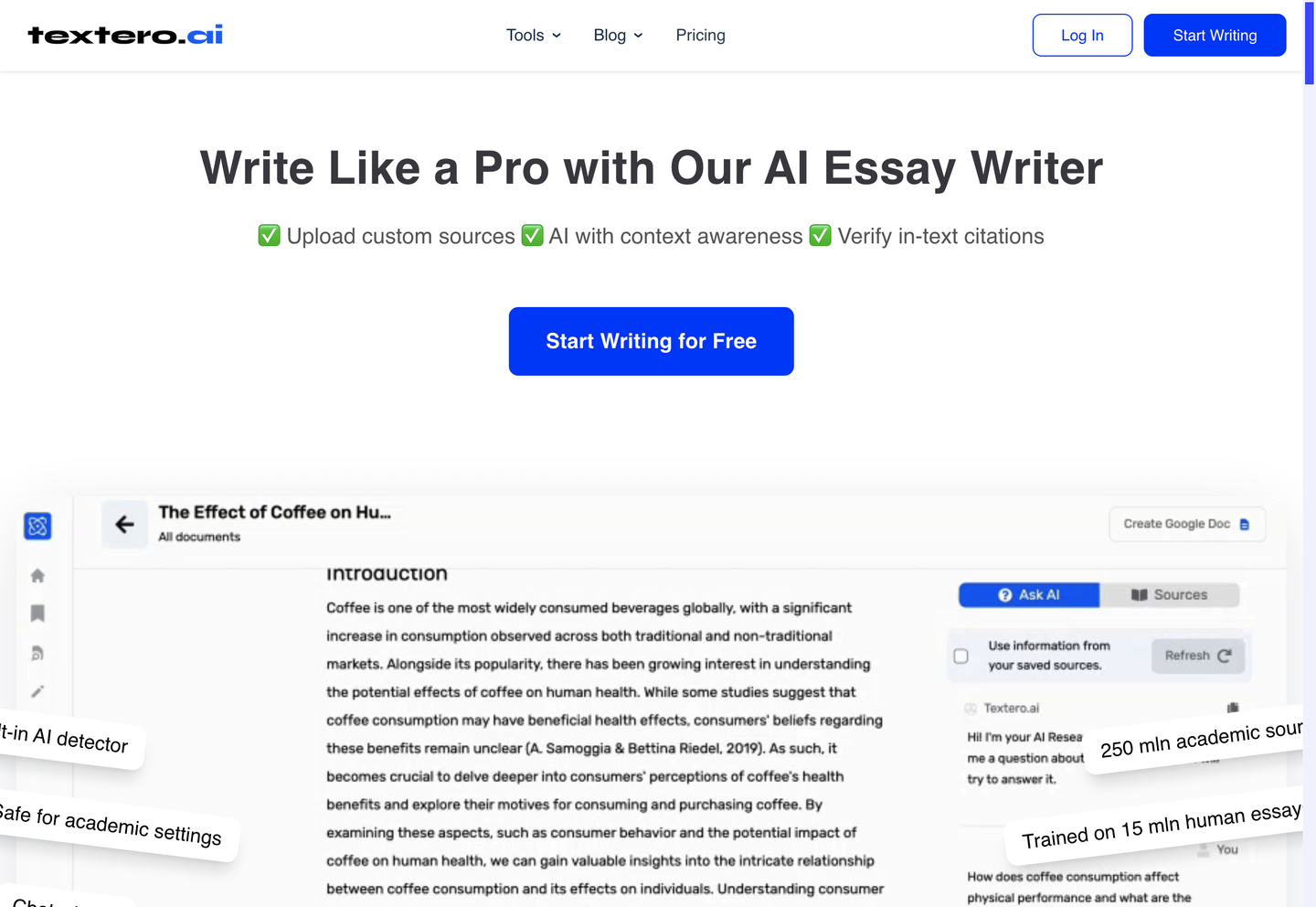
Students provide a topic, essay type, and any instructor guidelines or grading rubric, and Textero drafts a full essay rather than just an outline. Users can also upload PDFs directly, so the writer pulls from assigned course readings. Textero then lets students run a free AI detector to check the originality score, edit the text, and adjust tone before downloading the finished result as an editable Google Doc.

Main Features
AI Essay Writing Assistant
Textero generates a complete essay draft from a topic, essay type, and any extra instructions entered in its builder form. The AI pulls from training on academic writing patterns to structure an introduction, body paragraphs, and conclusion rather than a single block of text. Students get a workable draft to edit, not just a list of talking points.
Upload Files with Instructions
Students can upload a professor’s guidelines, grading rubric, or reading material directly into Textero before generating an essay. The system reads the uploaded file and adapts topic focus, required sources, and formatting to match those documents instead of relying on a generic prompt. This keeps the draft aligned with assignment-specific requirements that a blank prompt field would miss.
Academic Tone
Textero’s model is trained on a database of academic essays and scholarly writing to replicate formal tone, argument structure, and subject-specific vocabulary. Rather than producing conversational text that needs heavy rewriting, drafts arrive closer to the register instructors expect. Students still need to check terminology against their specific field, since general academic tone does not guarantee discipline-specific accuracy.
Plagiarism Checking
Textero includes a free AI detector and plagiarism check that scores a generated essay for originality before submission. Students run the check after editing, see a similarity or AI-score result, and revise flagged sections before downloading the final Google Doc. This step catches unedited AI phrasing that a quick read-through might miss, though it does not replace a university’s own plagiarism software.
Use Cases
-
Essay Writing
Students facing a deadline bring a topic, essay type, and instructor guidelines to Textero. Its AI Essay Writing Assistant and file-upload feature generate a structured draft with citations already built in, replacing a blank page with an editable document.
-
Editing Assistance
Students who receive a Textero draft review it against their assignment instructions and make edits before submitting. The AI detector shows an originality score so students know what to revise, and manual edits align wording with their own writing style.
-
Citing Sources
Students assembling a bibliography use Textero’s AI Citing Assistant to generate references in the format their assignment requires. The tool attaches citations to the generated essay automatically, so sources do not need to be looked up and formatted by hand afterward.
Best For / Not For
Textero is built for students who need a structured academic essay drafted quickly from a topic and course materials. Undergraduates writing weekly assignments, graduate students drafting shorter papers under deadline pressure, and non-native English speakers who want help with academic tone and phrasing all fit the tool’s core workflow. Generated text and citations still require human verification for accuracy, relevance, originality, and compliance with academic-integrity rules, so Textero does not fit students who need a fully autonomous, submission-ready paper without review. It also lists no institutional plan, so writing centers managing many accounts need a workaround.
Pricing
Textero charges $19.99 per user per month on the standard Premium Monthly plan, with lower per-month rates for quarterly and annual billing, and a free tier for occasional use.
| Plan | Price | Included |
|---|---|---|
| Free Premium | Free | 5 AI Credits/day, 5 AI Commands/day, Unlimited PDF uploads |
| Premium Yearly | $8.25 / user/month, billed annually | Unlimited AI Credits, Unlimited AI Commands, Unlimited PDF uploads |
| Premium Quarterly | $14.99 / user/month, billed monthly | Unlimited AI Credits, Unlimited AI Commands, Unlimited PDF uploads |
| Premium Monthly | $19.99 / user/month, billed monthly | Unlimited AI Credits, Unlimited AI Commands, Unlimited PDF uploads |
The Free Premium plan caps usage at 5 AI credits and 5 AI commands per day, so heavier essay or editing work requires upgrading to a paid tier.
Pricing checked 2026-10-25.
Quick Comparison
Book AI Writer is Textero’s main alternative for generating long-form written documents from a prompt. Book AI Writer focuses on full ebook production, generating chapter outlines, cover art, and export-ready files for self-publishing. Textero instead targets academic essays, pairing generation with an AI Citing Assistant and a built-in plagiarism check. Choose Book AI Writer if you are self-publishing a full-length ebook with cover design. Choose Textero if you need a cited academic essay with a plagiarism check.
Verdict
Textero generates cited academic essays from a topic and uploaded instructions, with Premium Yearly priced at $8.25 per user per month for unlimited AI credits. The Free Premium tier caps daily output at 5 credits, fitting occasional drafts better than heavy semester-long writing.