
Scholarcy: AI Summarizer for Researchers
Which tool converts a dense research paper into a structured flashcard summary? Scholarcy does: a Sumarizer tool that converts papers, articles and textbooks into flashcard summaries for researchers and students. Over 600,000 people have signed up. Teams needing literature discovery across hundreds of unindexed papers should consider Genei instead.
- United States 27.8%
- United Kingdom 24%
- India 4.7%
- Philippines 3.5%
- Other 40%
What Scholarcy Does
For researchers and students, Scholarcy converts papers, articles, textbooks and videos into interactive flashcard summaries without manual skim-reading of each source.
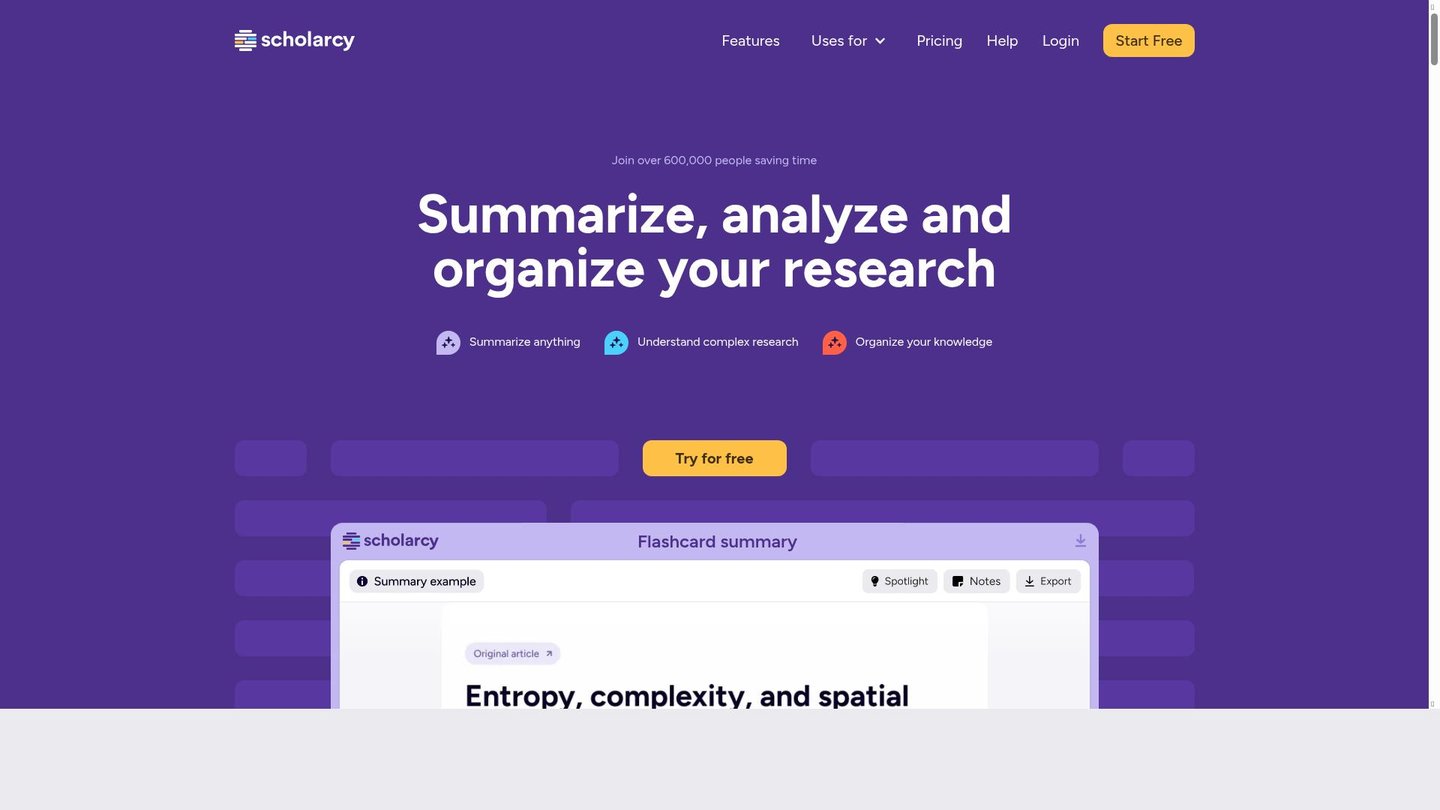
Scholarcy extracts key findings, methods, limitations, references, tables and figures from imported PDFs, Word docs, browser-based articles, or video transcripts into a consistent flashcard format. The Enhance feature adjusts summary depth, from a single sentence to a researcher-level overview, and Spotlight jumps straight to key concepts and contributions instead of a full read-through. Smart highlighting flags sections worth closer attention, and saved flashcards organize into searchable collections instead of scattered files across folders.
Main Features
Flashcard Summaries
Scholarcy converts long complex texts into interactive summary flashcards that highlight key information, including findings, methods and limitations. It works on papers, articles, textbook chapters and videos. The flashcard format stays consistent across documents, so comparing ten papers follows the same structure instead of ten different layouts.
Enhanced Summaries
The Enhance feature lets users change summary depth to match reading style, ranging from a single-sentence overview to a researcher-level breakdown. This adjusts how much detail Scholarcy surfaces from the same source document. A student scanning for relevance and a researcher checking methodology can pull different detail levels from one import.
Spotlight & Critical Analysis
Spotlight takes users straight to important points, key concepts and contributions instead of requiring a linear read. Smart highlighting and analyzing features guide readers to significant sections and help interpret them. This cuts the need to scan a full document for the parts that actually matter to the research question.
Import, Organize & Export
Scholarcy imports files from browsers, folders of PDFs or Word docs, and integrates with Zotero, Google Drive and YouTube. Flashcards can be organized into collections, annotated with notes, and exported up to 100 at a time on paid plans. Free users export one flashcard at a time, which limits bulk workflows.
Use Cases
-
Students summarizing readings
Students bring assigned readings and tight deadlines to Scholarcy. They use flashcard summaries, notes and highlights to prepare for exams instead of rereading full chapters. The free tier covers up to ten summaries before a subscription is required.
-
Researchers evaluating texts
Researchers bring stacks of papers that need critical evaluation before a literature review proceeds. Scholarcy’s smart highlighting and Spotlight surface key concepts and contributions for comparison across studies. Collections keep the resulting summaries organized by project or topic.
-
Building a searchable research library
Anyone accumulating dozens of PDFs over a semester or project needs a way to find a specific finding later. Scholarcy’s collections and search let flashcards be sorted and retrieved by topic. One-click bibliographies then handle citation formatting for whichever papers get cited.
Best For / Not For
Scholarcy is built for people who process many documents and need a consistent summary format rather than rereading each one from scratch, especially across dozens of papers in a single project. Students preparing for exams from assigned readings and Researchers screening or comparing multiple papers before a literature review are the named audiences. Scholarcy can omit nuance or misinterpret technical findings in its summaries, so anyone citing a claim in published work must verify it against the original source rather than trusting the flashcard alone, particularly for statistical results or methodology details.
Pricing
Scholarcy prices itself with a free Article Summarizer capped at 10 summaries, a Monthly plan at $9.99 per user per month that unlocks unlimited summarization, and an annual Scholarcy Plus plan at $90 per year with a built-in discount.
| Plan | Price | Included |
|---|---|---|
| Free Article Summarizer | Free | Limit of 10 summaries |
| Monthly plan | $9.99 / user/month, billed monthly | Unlimited summarization |
| Scholarcy Plus | $90 / year, billed annually |
The free Article Summarizer exports only one flashcard at a time, while both paid tiers raise that limit to 100 flashcards per export and add collections, notes and literature matrix creation. The Monthly plan includes a 1-week free trial; billing starts automatically afterward at the standard monthly rate unless the subscription is cancelled first.
Pricing checked 2026-10-26.
Quick Comparison
Genei is Scholarcy’s main alternative for turning PDFs and webpages into structured research notes. Genei focuses on structured note-taking across multiple sources during literature discovery. Scholarcy differentiates with flashcard-format summaries, Enhance reading-level adjustment and one-click bibliographies for individual documents. Choose Genei if the task is building notes across a broad literature search. Choose Scholarcy if the task is converting individual papers into structured, exportable flashcards quickly.
Verdict
Scholarcy processes papers, articles, textbooks and videos into flashcard summaries for researchers and students, with the free tier capped at 10 summaries before Monthly pricing at $9.99/month unlocks unlimited use. It fits single-document review better than broad literature discovery across many sources.


