
Refire: Design Tools for Startup Founders
Which service turns a rough product idea into build-ready screens without a design department? Refire, a Design Tools tool, scopes an MVP, maps flows, and prepares implementation-ready interfaces for startup founders. Teams wanting a self-serve collaborative design workspace instead of a senior-led engagement should consider Designerr.
What Refire Does
Refire turns an ambiguous product idea into a scoped MVP with mapped flows and build-ready screens, without hiring a separate product strategist, UX designer, and QA reviewer.
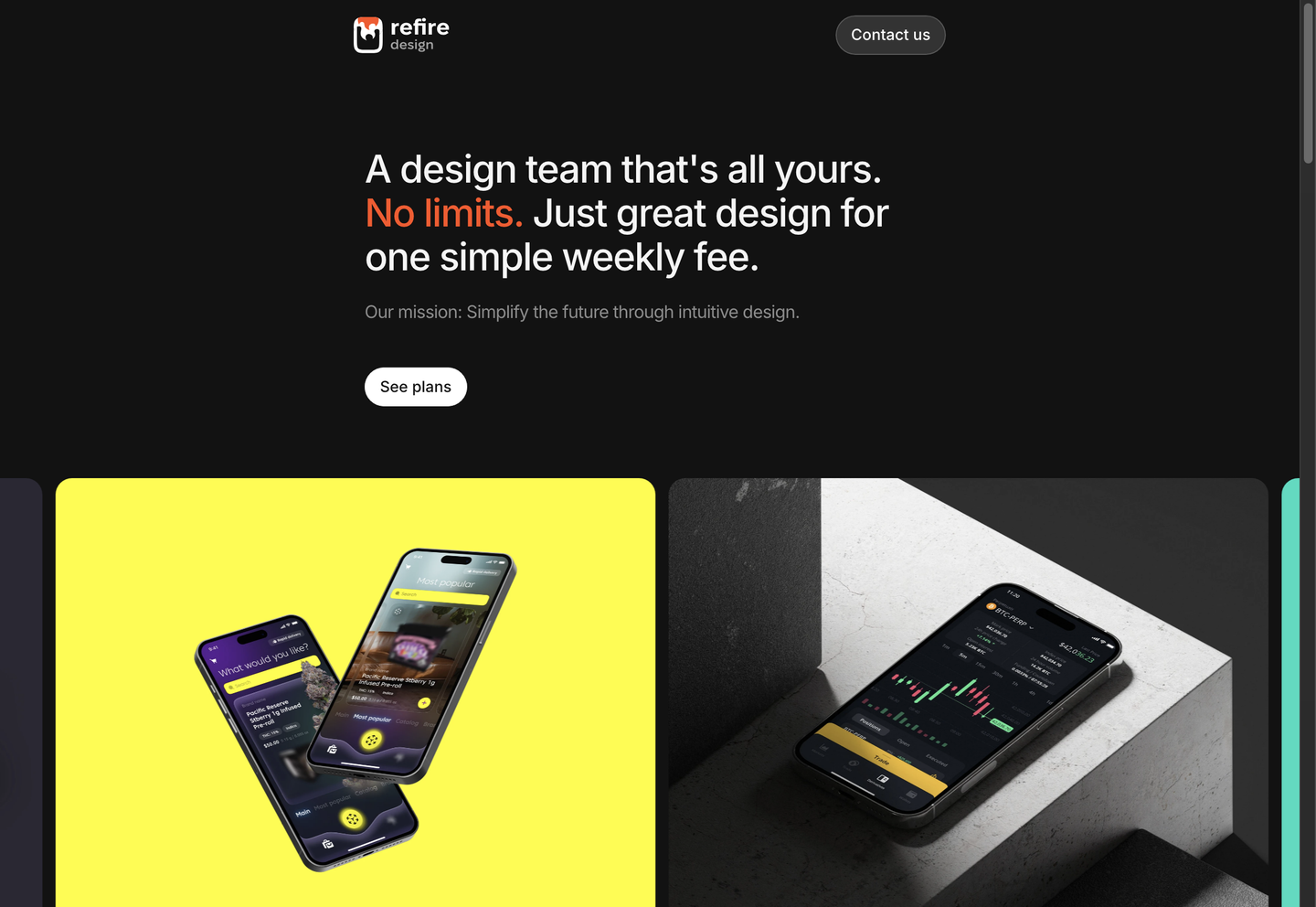
Refire defines the first useful release, maps user journeys across roles and states, and organizes product structure before visual work begins. It builds code-driven prototypes to test decisions early, runs structured UI quality assurance loops, and produces frontend-ready screens with implementation notes. The work covers regulated flows, payments, and marketplace logic, as shown in its Oladoctor and Payllet work. Founders get one scoped engagement instead of coordinating a strategist, a UX designer, and a build-prep contractor separately.
Main Features
MVP Scope and Product Logic
Refire defines the first useful release by identifying the core user job, prioritizing features, and deferring secondary work until the core flow is validated. It sequences these decisions before any screen is drawn, documenting what ships first and what waits. This ordering means founders avoid building extra features before the primary user job is proven, which keeps the initial build small enough to launch and test quickly.
UX Flows and Information Architecture
Refire maps user journeys, roles, states, and decision points, then organizes product structure and navigation ahead of visual design. Dashboards, payments, and marketplace products need this mapping because multiple user types trigger different screens and permissions. This ordering means interface work starts from a tested logic map rather than guesswork, which reduces rework once screens enter production and developers start building against them.
Code-Driven Prototypes and UI QA
Refire builds code-based prototypes to test and communicate product decisions, then runs structured review loops to catch interface and implementation issues before release. Testing decisions in running code rather than static mockups surfaces logic gaps that a flat image cannot reveal, so developers inherit a prototype that already reflects real interaction states instead of a set of disconnected screens.
Build Preparation and Frontend Support
Refire produces frontend-ready screens, implementation notes, and launch assets, and plans or supports frontend, backend, API, and integration work when relevant to the project. Founders hand developers a scoped package with documented states and copy instead of a loose set of static designs, which shortens the gap between design sign-off and a working release.
Use Cases
-
Startup founders or early product teams
Founders with an undefined MVP scope bring a rough idea or prototype to Refire. Refire clarifies the core user job, prioritizes features, and prepares flows and screens for implementation, so the first build targets one validated path instead of a feature list.
-
Product teams launching a web application
Teams building a product with multiple user roles and workflow states need journeys mapped before code starts. Refire maps edge cases, interface states, and product copy, which gives developers a complete reference instead of partial screens.
-
Existing teams improving a dashboard or design system
Teams maintaining dashboards across many screens need reusable UI patterns and implementation checks. Refire provides interface systems, UI QA, and frontend-aware preparation, so new screens stay consistent with the existing pattern library.
Best For / Not For
Refire is built for teams that need product scoping, UX, and build-ready screens in one engagement rather than piecemeal design help.
Refire fits startup founders or early product teams with an unscoped idea, product teams launching a web application with multiple roles and states, and existing teams improving a dashboard or design system across many screens.
Refire is a services-led engagement, not a self-serve software tool, so teams wanting an immediately deployable design app should look elsewhere; it also does not publicly document integrations with third-party software.
Pricing
Refire does not publish pricing on its site; the model is custom and quoted per project rather than sold through fixed monthly or annual plans. No per-screen rate, retainer figure, or package price is listed publicly, so the cost of any engagement depends entirely on the scope agreed with the vendor.
| Pricing model | Custom / on request |
|---|---|
| Public price | Not listed |
| How to buy | Contact the vendor for a quote |
Because engagements are scoped per project, the table cannot show per-screen rates, typical project length, or what happens once a scoped engagement grows beyond its original brief.
Pricing checked 2026-11-09.
Quick Comparison
Designerr is Refire’s main alternative for teams that want a self-serve design workspace rather than a scoped engagement. Designerr gives teams direct, ongoing access to templates and editing tools without booking a project. Refire instead runs UX flows, code-driven prototypes, and UI QA as a senior-led engagement through to build preparation. Choose Designerr if a team wants continuous self-serve design output. Choose Refire if a founder needs one scoped engagement that turns an unscoped idea into implementation-ready screens.
Verdict
Refire scopes MVPs and builds code-driven prototypes for startup founders, covering regulated flows like its Oladoctor healthcare work. It suits teams needing scoping, UX, and build prep together, not a self-serve platform.


