
Prompt Engineering for AI Builders with Prompthub
Most Prompt Engineering tools lock prompt work inside one team’s codebase; Prompthub stores prompts in a public, Git-versioned workspace anyone can browse or fork. AI builders get a shared library, so Prompthub fits early collaboration rather than closed pipelines. Built for small teams — enterprises needing SSO at no cost will hit its free-tier ceiling.
- United States 28.7%
- India 14.8%
- Vietnam 6.3%
- Russia 3.9%
- Other 46.3%
What Prompthub Does
AI builders and non-technical team members use Prompthub to write, test, and version prompts inside one shared workspace, without touching a codebase.
Prompts live in a central repository with Git-style commits and branches, so changes can be tracked, reverted, and reviewed instead of overwritten in a shared document. A playground runs prompts across providers including OpenAI, Anthropic, Azure, Google, Meta, and Bedrock, with side-by-side output comparison, so teams can judge which model and phrasing perform best before shipping. Batch testing checks prompts against datasets at scale rather than one example at a time. Prompthub also exposes an API so stored prompts can be pulled into a live application at runtime.
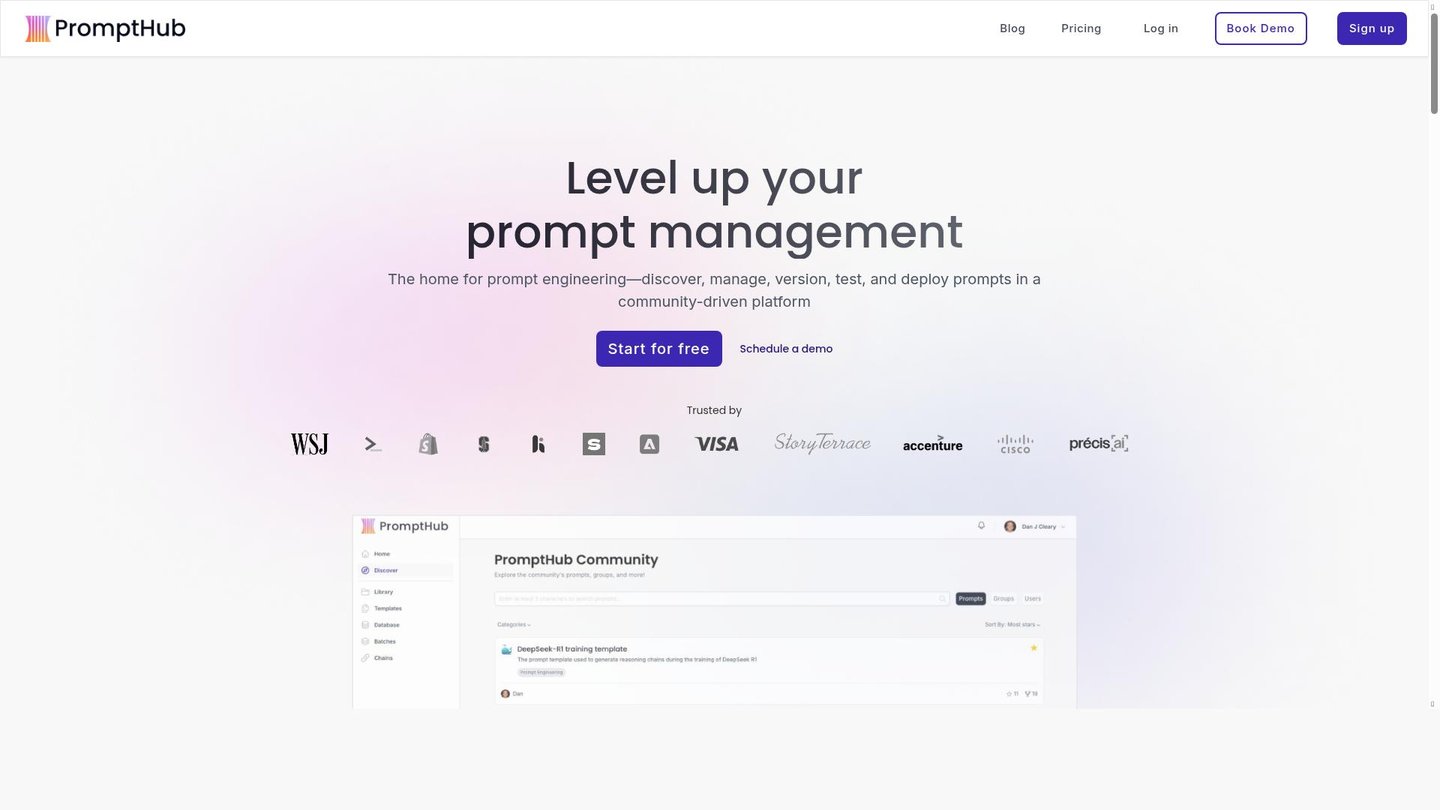
Main Features
Prompt Management
Prompthub organizes prompts in a central, searchable workspace rather than scattered documents or chat logs. Each prompt carries metadata, variables, and version history in one record. Teams can find and reuse prior work instead of rewriting prompts from scratch for every new project, model switch, or campaign that reuses similar instructions.
Collaboration Platform
Prompthub lets teams host unlimited public prompts with the community or keep them private internally once on a paid plan. Teammates view, comment on, and reuse shared prompts from one workspace. This gives non-technical reviewers, like subject matter experts, a route into prompt testing without needing to write or read code.
Versioning
Prompthub applies Git-based version control to prompts, with commits, branches, and a simple API for retrieval. Every edit is tracked rather than lost in copy-paste iterations across documents. Teams can roll back a prompt that regresses in production without reconstructing an earlier version from memory or old chat threads.
Security
Prompthub encrypts prompts, variables, and outputs at rest and in transit using AES-256 and TLS 1.2+, with regularly rotating keys. SOC 2 certification is listed as in progress, not completed, and reserved for the custom Enterprise plan. Teams handling sensitive prompt content should confirm current compliance status before signing a contract.
Use Cases
-
Reduce prompt development time
AI builders iterating on prompt wording and parameters can use Prompthub’s playground and side-by-side comparison to test variants against live models. Prècis AI reports increased prompt performance alongside reduced development time using the platform.
-
Streamline prompt testing
Non-technical team members, including subject matter experts, need a way to evaluate prompts without writing code. Prompthub’s collaboration platform and playground open testing to reviewers directly. Heidi Health used this to make prompt testing systematic across its team.
-
Centralize prompt management
Content generation services running many prompts across projects can consolidate them in Prompthub’s central repository with versioning. Unifire reports creating, testing, and deploying prompts ten times faster after centralizing its stack in Prompthub.
Best For / Not For
Prompthub is built for teams and individuals who write, test, and ship prompts as part of an AI product rather than as a one-off task.
Prompthub fits AI builders iterating on model prompts, non-technical team members who need to review and test prompts without code, and content generation services running prompt libraries across client projects.
Prompthub’s free plan makes all prompts public and caps usage at 2,000 requests per month, so teams needing private prompts or SSO/SAML from day one, without paying for Team or Enterprise, should look elsewhere.
Pricing
Prompthub’s standard pricing starts with a free tier, then Pro at $9 / user/month and Team at $15 / user/month, both billed monthly.
| Plan | Price | Included |
|---|---|---|
| Free | Free | Unlimited team members, unlimited public prompts, no private prompts, 2,000 requests/month, 10 prompt enhancements/month, limited API access |
| Pro | $9 / user/month, billed monthly | Single user, unlimited public prompts, unlimited private prompts, 10,000 requests/month, 200 prompt enhancements/month, full API access |
| Team | $15 / user/month, billed monthly | Unlimited team members, unlimited public prompts, unlimited private prompts, 50,000 requests/month, 500 prompt enhancements/month |
Requests and prompt enhancements reset monthly and do not roll over; LLM provider token costs for OpenAI, Anthropic, and similar services are billed separately by the provider.
Pricing checked 2026-10-26.
Quick Comparison
PromptLayer is Prompthub’s main alternative for production prompt observability and monitoring. PromptLayer offers more mature release controls, analytics, and production monitoring for teams running prompts at scale. Prompthub counters with a free public-prompt community and Git-style collaboration starting at Free, with Pro at $9 / user/month. Choose PromptLayer if production monitoring and analytics are the priority. Choose Prompthub if a lower entry price and community-driven collaboration matter more.
Verdict
Prompthub stores and version-controls prompts for AI builders at a free tier capped at 2,000 requests and 10 prompt enhancements per month. Teams needing private prompts move to Pro at $9 / user/month; those needing SSO stay on Enterprise.