Plaud for Executives: AI Meeting Assistant Hardware
Plaud is a AI Meeting Assistants that records conversations on dedicated hardware and turns them into structured, searchable notes. Executives use Plaud to capture discussions and delegate decisions with a clear record. Plaud handles in-person and phone-call capture well, while cloud-only meeting bots still need a tool like Fathom.
- United States 28.7%
- Japan 28.1%
- France 4.4%
- Italy 3.9%
- Other 34.9%
What Plaud Does
Plaud turns recorded audio from meetings, calls, and in-person conversations into transcribed, speaker-labeled summaries in one capture-to-text pipeline.
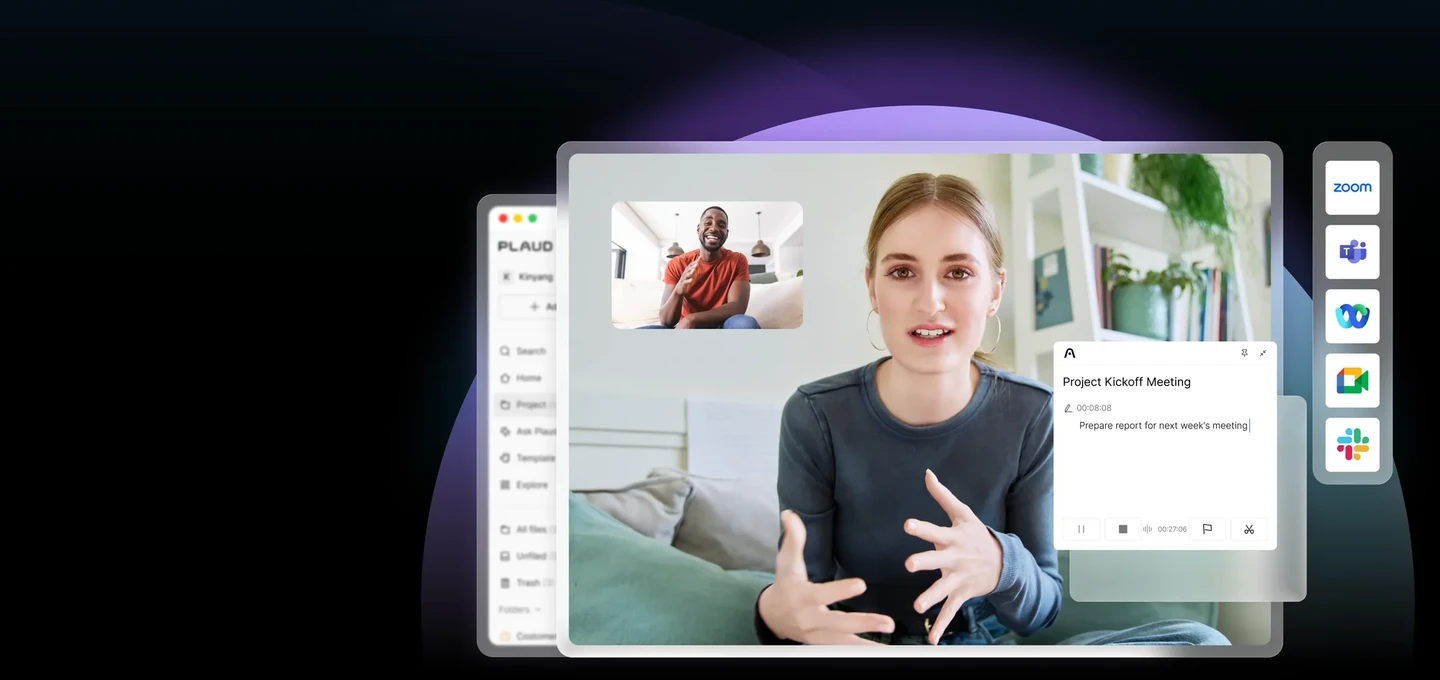
Plaud pairs a wearable or pocket recorder with an AI backend that transcribes speech, identifies individual speakers, and condenses the conversation into structured notes, decisions, and action items. Ask Plaud lets users query past recordings in natural language instead of scrolling through transcripts. Because capture happens on hardware rather than a meeting-platform bot, Plaud records conversations with no video-call link, such as patient visits or courtroom discussions, then syncs notes to web, desktop, and mobile.
Main Features
Audio Recording
Plaud devices capture in-person conversations and, on supported models such as Note and Note Pro, phone calls directly from the handset. Recording starts with a button press rather than opening an app or inviting a bot to a call. This means Plaud captures conversations a video-conferencing tool never sees, including hallway meetings and clinical visits.
AI Transcription & Speaker Identification
Plaud converts recordings into text in 112 languages and labels individual speakers with timestamps. The transcription engine runs after capture, producing a searchable text layer tied to the original audio. A labeled, timestamped transcript lets a user jump to the exact moment a decision was made instead of re-listening to the full recording.
AI Summaries & Rich Context Capture
Plaud condenses transcripts into structured summaries, key points, and decisions, and builds memory across sessions so later summaries reflect earlier context. Repeated client or patient conversations accumulate into a fuller record over time. This reduces how much a user has to manually cross-reference past notes before a follow-up meeting.
Global Security Standards
Plaud states it is built to SOC 2 Type II, ISO 27001, ISO 27701, GDPR, HIPAA, and EN 18031 compliance standards. These certifications cover data handling for regulated fields such as healthcare and legal work. Teams in those fields can evaluate Plaud against existing compliance requirements before adopting it for client-facing records.
Use Cases
-
Make better decisions
Executives use Plaud to capture every discussion during back-to-back meetings. AI transcription and summaries turn the recording into a decision log with assigned owners. This gives a clear record to delegate from without rewriting meeting notes afterward.
-
Close more deals
Sales reps use Plaud to record prospect calls on supported hardware while staying present in the conversation. Plaud transcribes the call and drafts a follow-up from the summary. The rep reviews and sends instead of writing call notes from memory.
-
Build a stronger case
Lawyers use Plaud to capture client meetings as accurate, searchable records. Speaker labeling and Ask Plaud let a lawyer retrieve a specific statement from a past meeting by query. Nothing discussed gets lost to an unrecorded conversation.
Best For / Not For
Plaud is built for people whose work happens in conversations rather than documents.
Executives, Sales reps, Clinicians, and Lawyers who need a record of meetings, calls, and client visits are the core fit, along with SMB Teams coordinating action items across people.
Plaud requires compatible hardware for its core recording experience, so a team wanting a software-only, bot-joins-the-call workflow across Zoom and Teams without buying a device should look elsewhere; Plaud also does not list team SSO as available, which limits it for IT-managed enterprise rollouts.
Pricing
Plaud’s software plans start with a free Starter tier and run to $300 per user per year for Team, billed annually, on top of hardware that runs $159 to $189 per device.
| Plan | Price | Included |
|---|---|---|
| Starter | Free | 300 transcription minutes/month |
| Pro | $100 / user/year, billed annually | 1,200 transcription minutes/month |
| Unlimited | $240 / user/year, billed annually | unlimited transcription minutes |
| Team | $300 / user/year, billed annually | varies by user |
The table does not cover device cost, which is separate from the subscription, or what happens to a Starter account once its 300 monthly minutes run out.
Pricing checked 2026-11-02.
Quick Comparison
Fathom is Plaud’s main alternative for teams running meetings entirely on Zoom, Google Meet, or Microsoft Teams. Fathom joins calls as a bot and records directly from the video platform, needing no hardware purchase. Plaud instead captures in-person conversations and phone calls through dedicated devices like Note and NotePin. Choose Fathom if your team meets exclusively over video conferencing software. Choose Plaud if conversations happen in person, over the phone, or in rooms without a video link.
Verdict
Plaud processes recordings into transcripts across 112 languages and offers 300 free minutes monthly, scaling to 1,200 minutes on the $100/year Pro plan. It fits executives, sales reps, lawyers, and clinicians who need hardware-based capture of in-person and phone conversations, not teams locked into video-conferencing-only workflows.