
Linear for Development Teams: Organizational Assistant Platform
A development team shipping dozens of pull requests each week needs issues tracked without switching tools. Linear, a Organizational Assistant tool, connects issues, projects, and cycles to pull requests, returning a single workspace for planning and shipping work. Linear does not include built-in service-management workflows for complex Jira-style processes.
- United States 39%
- India 6.1%
- United Kingdom 5.8%
- Germany 4.7%
- Other 44.5%
What Linear Does
Linear is a product-development platform that organizes issues, projects, cycles, and roadmaps for software teams.
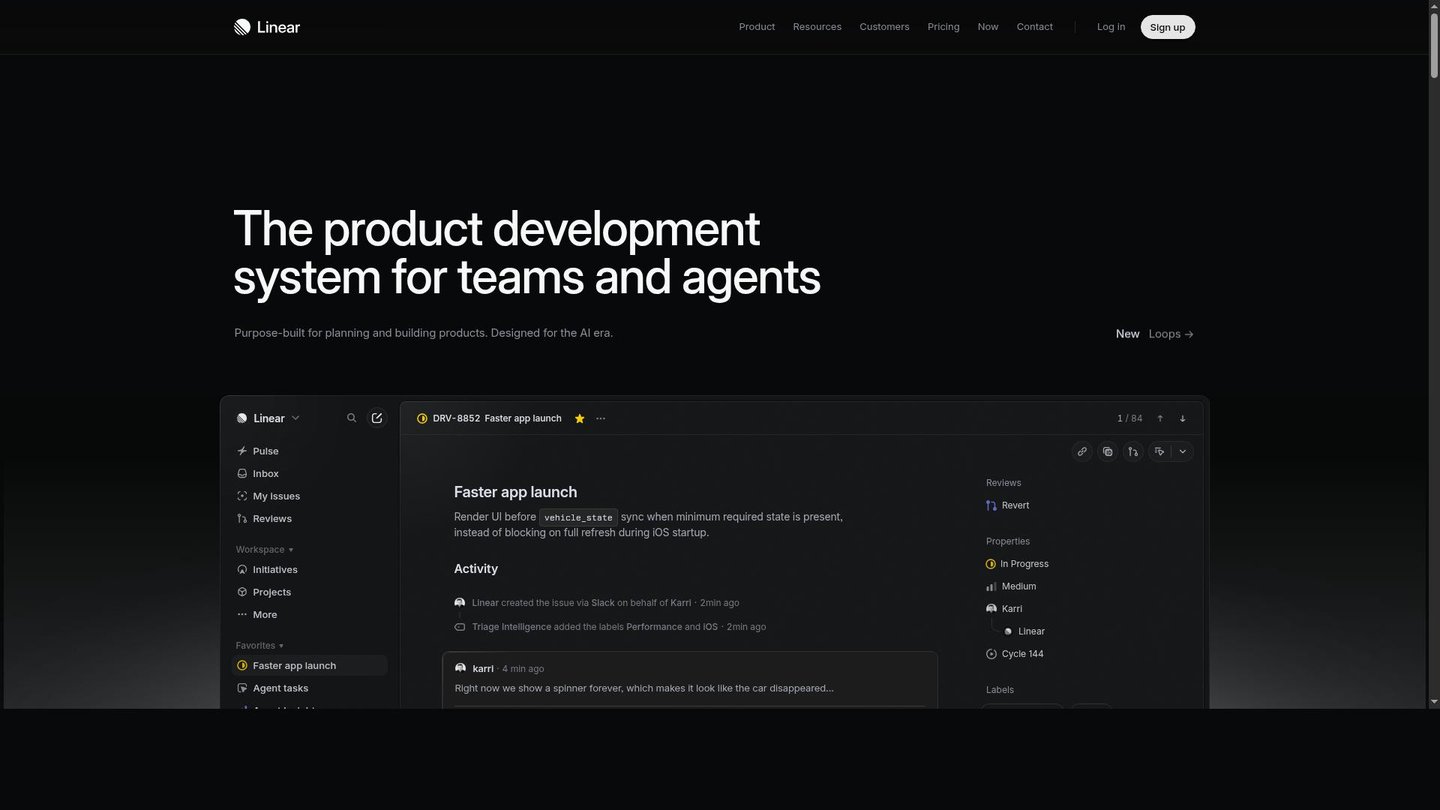
Software teams use Linear to replace scattered trackers, spreadsheets, and chat threads with one system for planning and building work. Triage captures incoming requests and routes them into issues, so nothing arrives without an owner. Linear Asks pulls feedback from Slack and other channels directly into trackable items, cutting the gap between a customer complaint and an assigned engineer. The result is a single record of what a team is building, why, and at what stage, rather than status scattered across tools.
Main Features
Issues and Projects
Linear groups individual issues into projects with milestones and progress tracking, so a roadmap item breaks down into assignable, trackable work. Each issue carries labels, priority, and an assignee, with status rolling up automatically to the project level. A team managing dozens of initiatives sees exactly which project an issue blocks, instead of cross-referencing a separate spreadsheet.
Cycles
Linear organizes work into time-boxed cycles, similar to sprints, that give a team a fixed window to commit to a set of issues. Each cycle tracks scope changes and completion rate as it progresses, so a team sees mid-cycle whether the committed work is slipping. This replaces manual sprint spreadsheets with a view built directly from the issues the team already tracks.
Triage
Linear’s Triage queue captures incoming issues, bug reports, and requests before they are assigned, letting a lead classify and route each one to the right team or cycle. Nothing enters the backlog unsorted, and items that need immediate attention surface ahead of a standard planning review. For teams fielding requests from multiple sources, this keeps the backlog ordered by actual priority instead of arrival order.
Integrations
Linear connects to services including GitHub, Slack, Zendesk, and Intercom to pull activity into issues. A GitHub pull request can link to and close its issue automatically on merge. Zendesk and Intercom integrations require the Business plan, so Free and Basic teams convert support tickets manually.
Use Cases
-
Ramp’s merged PRs
Development teams running high-volume code review use Linear’s coding agent as part of their merge workflow. Linear ties issues directly to pull requests and diffs, so reviews move from issue to merge without a separate tracker.
-
OpenAI scaled to 3,000 users
Product teams scaling product development chose Linear and grew usage to 3,000 users. Linear’s issues, cycles, and roadmaps hold planning for that many people in one workspace. Coordination runs through one shared system instead of fragmented tools.
-
Coinbase’s agent-first development
Development teams building with AI agents as teammates adopted Linear’s agent-first approach to enhance their workflows. Linear Agent lets an AI agent pick up, work on, and report on issues alongside human engineers. Agent-assigned work stays visible in the same tracker.
Best For / Not For
Linear is built for teams that ship software products and need planning tied directly to code review and release cycles.
Development teams use Linear Agent and issue sync to connect pull requests and work items. Product teams use roadmaps, cycles, and insights to plan initiatives across quarters.
Linear limits teams requiring deep workflow customization or complex service-management processes: it has no equivalent to Jira’s configurable workflow engine, so organizations migrating off a heavily customized Jira instance, as Oscar’s team did, should expect to rebuild workflows rather than import them wholesale.
Pricing
Linear offers a free plan with unlimited members, 2 teams, and 250 issues, while the first paid tier, Basic, costs $10 per user per month billed annually.
| Plan | Price | Included |
|---|---|---|
| Free | Free | Unlimited members, 2 teams, 250 issues |
| Basic | $10 / user/month, billed annually | All Free features + 5 teams, Unlimited issues, Unlimited file uploads, Admin roles |
| Business | $16 / user/month, billed annually | All Basic features + Unlimited teams, Private teams and guests, Triage Intelligence, Code Intelligence, Linear Insights, Linear Asks, Zendesk and Intercom integrations |
The table does not show Enterprise pricing, which is custom and available only by contacting sales, and both paid plans require annual billing.
Pricing checked 2026-11-11.
Quick Comparison
Reclaim is Linear’s main alternative for teams that prioritize calendar-based time management over issue tracking. Reclaim auto-schedules focus time and habits directly on a synced calendar, a function Linear does not offer. Linear wins on structured issue tracking, with Triage routing requests and Cycles organizing sprint-length work for engineering teams. Choose Reclaim if the priority is protecting calendar time across a small team. Choose Linear if the work centers on tracked engineering issues and release cycles.
Verdict
Linear organizes issues, cycles, and roadmaps for software teams across more than 50,000 organizations, with the first paid plan priced at $10 per user per month billed annually. Development and product teams get one system instead of scattered trackers. Large deployments require Enterprise pricing.


