Generated Photos for Researchers: Synthetic Face Stock Images
Training a recognition model on real portraits means clearing consent and licensing before a single image ships. Generated Photos is a synthetic-identity library, a Stock Images tool, that generates faces and full-body humans by parameter instead of camera. Particularly strong at parameter-based face generation at scale — not built for documentary or video output.
- United States 42.3%
- Belgium 5.3%
- India 4.4%
- Japan 3.5%
- Other 44.5%
What Generated Photos Does
Generated Photos solves the licensing and consent problem by generating people who do not exist, from a studio-trained model rather than a camera.
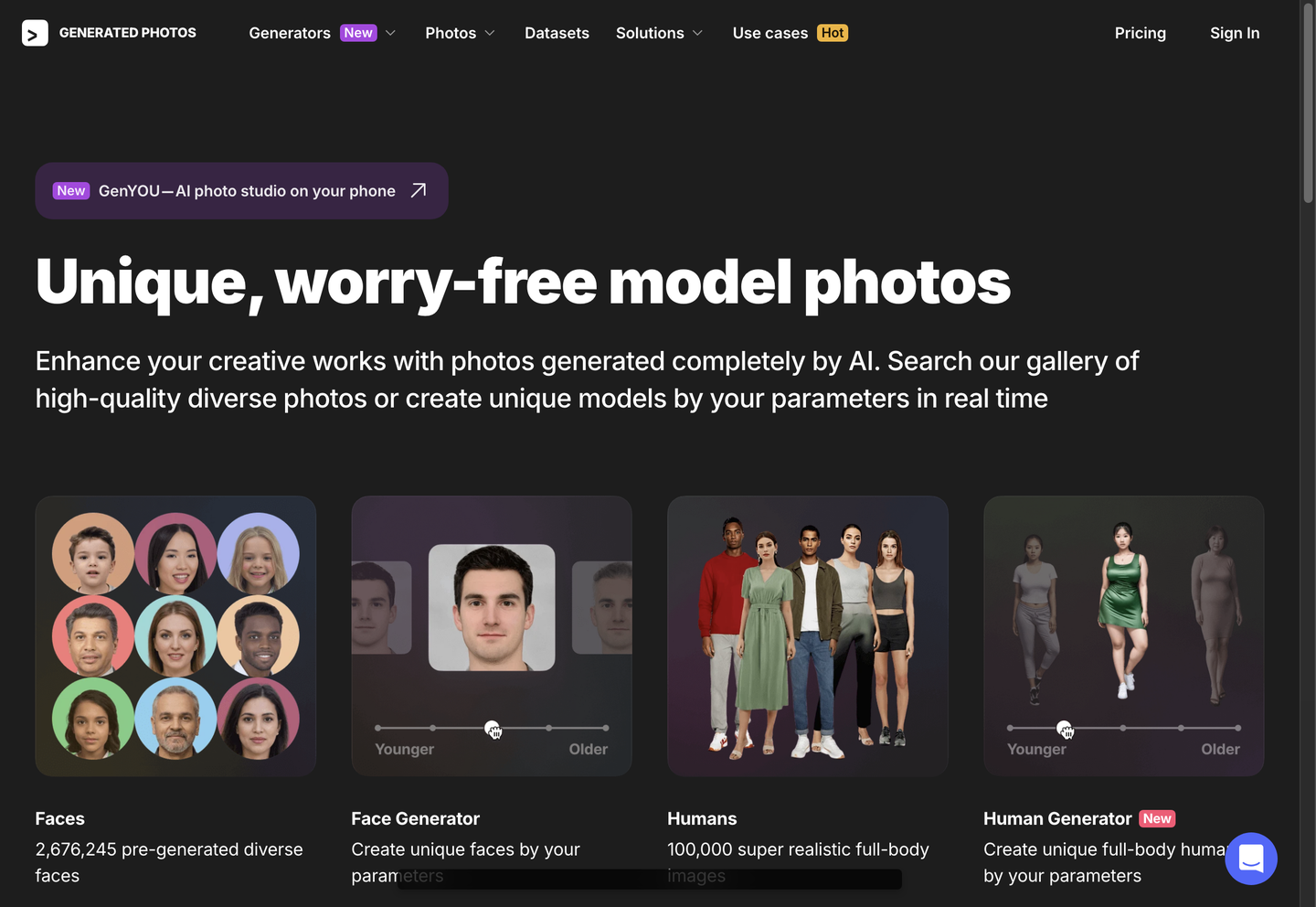
The catalog holds over 2.6 million pre-made faces and more than 167,000 full-body humans, searchable by age, gender, ethnicity, and expression. The Face Generator and Human Generator produce new variants in real time by adjusting parameters such as skin tone, pose, clothing, and background. Generated Photos states its images come from model-released studio photography, which the company positions as BIPA- and GDPR-safe with no personality-rights exposure. Bulk purchase and API access extend the same library into dataset-sized or application-embedded workflows.
Main Features
Face Generator
Creates unique synthetic faces in real time by adjusting facial characteristics, expressions, skin tones, ages, and head position. Generated Photos draws from a base of 2.6 million pre-made faces, so a close match can be refined rather than built from scratch, and generations themselves are unlimited even though monthly downloads are capped at 15 on the standard plan, which limits heavy single-month usage without an upgrade.
Human Generator
Generates full-body synthetic people with adjustable body types, poses, clothing, and backgrounds, backed by a library of 167,000-plus ready-made humans and 1,000 priority generations a month. Generated Photos separates this from the face-only plan, so buyers needing full-body assets pay for a second $199/year subscription rather than one combined tier covering both catalogs.
Anonymizer
Takes an uploaded portrait and produces a synthetic twin with similar characteristics, replacing the real likeness with a generated one while preserving traits like age and expression. Security and research teams use this to anonymize biometric data, so a dataset can retain visual diversity and usability for analysis without exposing an identifiable face to downstream handlers.
API Access
Integrates the face library and Anonymizer into live applications and services, giving developers programmatic access to the same assets available through the web interface. The API is scoped for online use only; Generated Photos does not permit caching, stockpiling, or redistribution through it, so it cannot substitute for a bulk dataset purchase on larger offline projects.
Use Cases
-
AI training with diverse images
Researchers building recognition or detection models pull diverse synthetic faces instead of sourcing consented portrait sets. Generated Photos supplies controllable identities, emotions, and skin tones across its 2.6-million-face catalog, so training sets can be assembled without individual releases.
-
Anonymizing biometric data
Security teams need to keep biometric records usable without exposing a real face. Generated Photos’s Anonymizer swaps uploaded portraits for a synthetic twin with matching characteristics, so confidentiality holds while the data retains analytical value.
-
Creating UI designs
Designers populate application mockups with realistic people instead of arranging a photo shoot. Generated Photos’s Face and Human Generators supply diverse synthetic faces and bodies on demand, so interface prototypes avoid stock-photo licensing questions.
Best For / Not For
Generated Photos is built for people who need volume and control over synthetic identities rather than one-off photography.
Researchers training or testing models, Security teams anonymizing biometric records, and Designers populating interfaces or marketing mockups are the core fit; Academics studying visual perception use the same faces as controlled stimuli.
Generated Photos does not produce documentary photography or video, and its API blocks caching or dataset compilation, so teams needing offline bulk archives must use the separate bulk-download or dataset purchase path instead.
Pricing
Generated Photos prices its Faces and Humans subscriptions at $199 per user per year each, with bulk single-image purchases starting at $5 per photo for mid-size orders.
| Plan | Price | Included |
|---|---|---|
| Bulk download | $5 / photo | 51-250 photos |
| Faces + Face Generator | $199 / user/year, billed annually | 15 downloads/month, unlimited face generations |
| Humans + Human Generator | $199 / user/year, billed annually | 15 ready-made humans/month, 1,000 priority generations |
The table does not show that bulk pricing drops further at volume, to $2.50 per photo above 250 and $1 above 1,000, and that trial images carry watermarks.
Pricing checked 2026-11-09.
Quick Comparison
Stockimg AI is Generated Photos’s main alternative for teams that want prompt-driven image generation beyond faces and people. Stockimg AI covers logos, posters, and broader design assets generated from open text prompts. Generated Photos wins on structured identity control, with parameter-based Face and Human Generators and a 2.6-million-face catalog built specifically for synthetic people. Choose Stockimg AI if the project needs varied design assets from a single prompt box. Choose Generated Photos if the job is specifically synthetic human faces or bodies at dataset scale.
Verdict
Generated Photos generates from a catalog of 2.6 million faces at $199 per user per year, giving researchers a licensed synthetic source instead of a photo shoot. It fits dataset and anonymization work, not video or documentary imagery.