
BrowserAct: AI Agents for Web Scraping Automation
Manual scraping breaks the moment a site adds a CAPTCHA or changes layout. BrowserAct is a cloud scraper-building platform, a AI Agents tool, that turns a plain-language description into a reusable, verified scraper. Best fit for developers running parallel browser tasks on protected sites — teams needing simple point-and-click monitoring should look elsewhere.
- China 18%
- Hong Kong 8.2%
- United States 7.8%
- Singapore 6.1%
- Other 59.9%
What BrowserAct Does
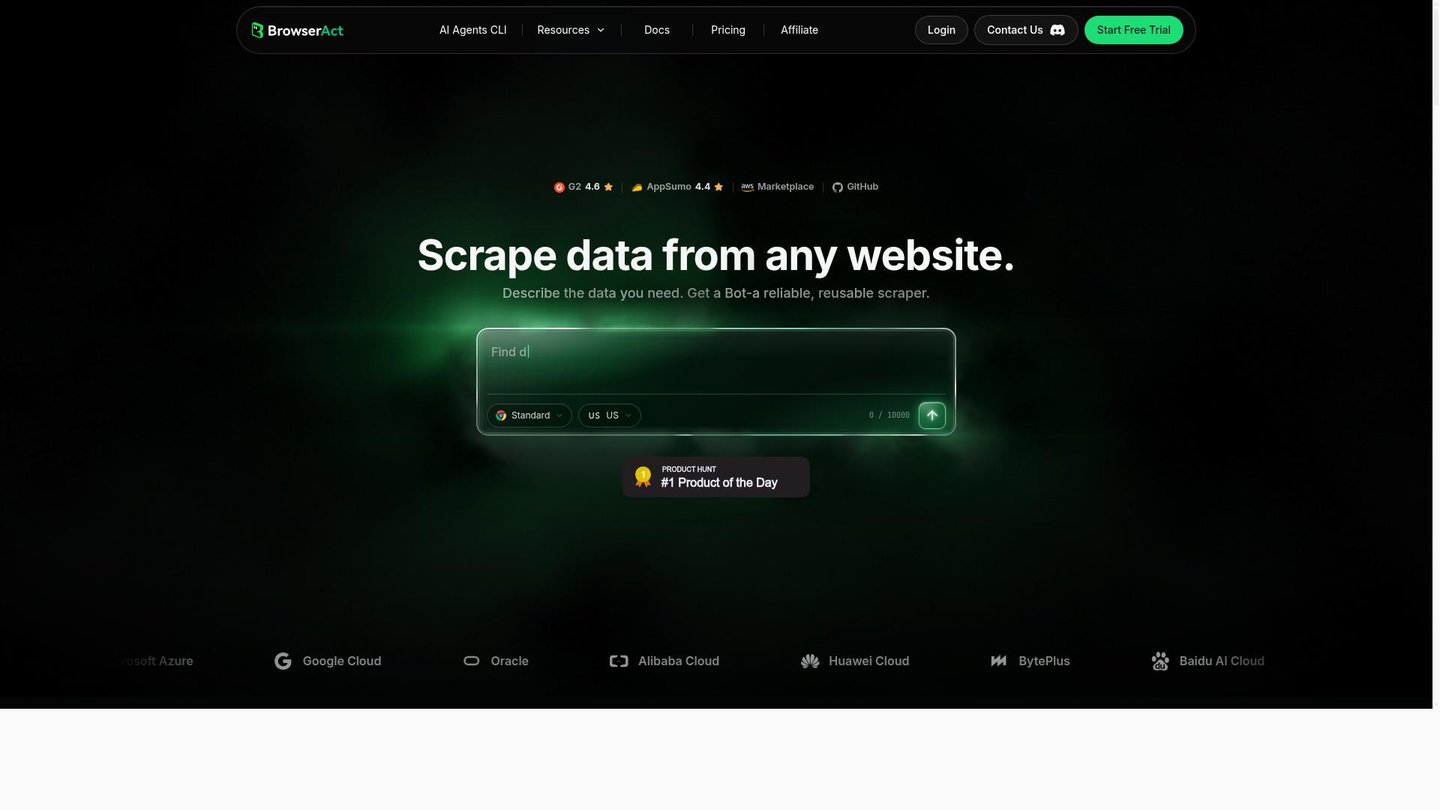
BrowserAct converts a written description of the data you want into a working scraper that runs in a real browser. Users describe target fields, and BrowserAct builds, tests, and verifies extraction before delivering results. The scraper is reusable, so the same job runs again without being rebuilt. BrowserAct handles CAPTCHAs and session isolation in its managed browser, and hands off to a human when a run gets stuck on verification.
BrowserAct connects to Make, n8n, and Zapier, so published Bots feed extracted data into downstream workflows directly.
Main Features
Natural-language scraper creation
Users describe the data they need in plain sentences, and BrowserAct converts that description into a runnable scraper without selectors or code. The system maps the request to page elements automatically. This removes the setup step that usually requires a developer, so non-technical staff can launch a scraping job directly.
Real-browser execution
BrowserAct runs scrapers inside a live browser rather than a static HTTP fetch, so it can click through pagination, submit forms, and load detail pages that render only after JavaScript executes. This lets scrapers reach dynamic sites that simple HTML parsers cannot handle, which matters for listings that load content on scroll.
CAPTCHA handling and human hand-off
Stealth browsing and built-in CAPTCHA resolution let BrowserAct reach pages that block standard bots, and when a run still gets stuck, it hands off to a human operator for the blocked step. That combination keeps a scraping job moving past verification screens instead of failing the whole run.
Enterprise Security & Compliance
BrowserAct isolates sessions and cookies per browser profile, with one-click proxy assignment and residential proxy pools priced by data volume. Fingerprint isolation keeps each profile unique at scale. No public compliance certifications (SOC 2, ISO 27001) were found in the available research, which buyers with strict vendor-review requirements should verify directly.
Best For / Not For
BrowserAct is built for people who need scraped data refreshed on a schedule rather than pulled once, and who are comfortable working through a credit-based cloud setup instead of a flat-price plan. Typical users include research analysts collecting data from thousands of listing or product pages, RevOps teams refreshing lead directories without rewriting scripts each cycle, and automation developers running parallel browser tasks across multiple sites with session isolation and CAPTCHA handling built in. BrowserAct is not a fit for teams needing only a single one-off extraction, since its credit-based pricing across browsers, proxies, and workflow steps is built around recurring, reusable jobs rather than a quick single-run scrape.
Pricing
BrowserAct does not publish a flat plan price; it runs on a pay-as-you-go credit pool covering browsers, proxies, and workflow steps, alongside a free tier and a 7-day trial with trial credits included on any subscription.
| Pricing model | Custom / on request |
|---|---|
| Public price | Not listed |
| Free tier | Yes |
| Free trial | 7 days |
| How to buy | Contact the vendor for a quote |
Credits are drawn per service — local browsers, proxy bandwidth by the GB, and workflow steps by the action — so total cost scales with usage, and unused credits do not carry a listed rollover policy.
Pricing checked 2026-08-04.
Quick Comparison
Open Interpreter is BrowserAct’s main alternative for developers automating browser and system tasks with code. Open Interpreter runs local code execution against a user’s machine and files, suiting code-first control. BrowserAct instead runs jobs in a managed cloud browser with CAPTCHA handling and session isolation, so scrapers survive site changes. Choose Open Interpreter for local, code-first system automation. Choose BrowserAct for reusable, cloud-hosted scrapers that need to clear CAPTCHA walls.
Verdict
BrowserAct runs reusable scrapers with a 7-day trial and a free tier, pricing usage through credits for browsers, proxies, and workflow steps. It fits developers and analysts needing recurring, CAPTCHA-resistant extraction over one-off jobs, but offers no flat published plan for buyers comparing fixed monthly costs.