See how Google AI Mode compares to traditional search, AI Overviews, ChatGPT, and Perplexity. Key findings, overlaps, and SEO tactics from a new study.
Overview
Google’s AI Mode is changing how people discover and evaluate information. A new study compared AI Mode with traditional Google results, AI Overviews, ChatGPT, and Perplexity to uncover how links, citations, and responses differ. Read the original research here: Google AI Mode vs. Traditional Search & Other LLMs.
Key Findings at a Glance
- Sidebar linking dominates: 92% of AI Mode answers include a sidebar with links, averaging ~7 unique domains.
- Organic overlap varies: Sidebar links show ~54% domain and ~35% URL overlap with Google’s top 10; links below responses (7% of queries) show 89% domain and 80% URL overlap.
- Perplexity aligns most with Google: ~91% domain and ~82% URL overlap.
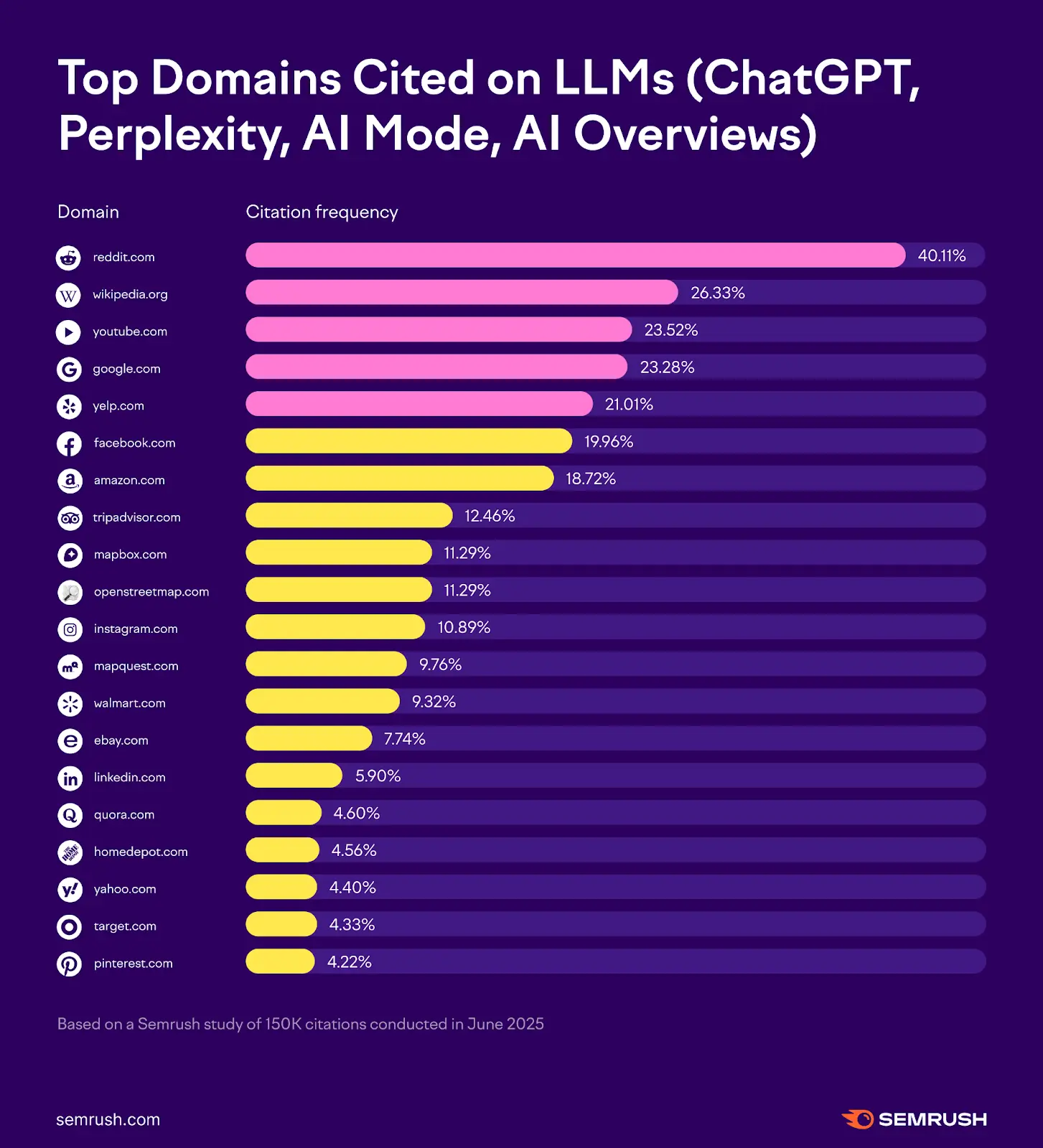
- Reddit leads citations: UGC platforms like Reddit, YouTube, and Facebook appear across LLMs.
- Intent shapes length: Commercial and transactional queries trigger responses about 2x longer than informational ones.
- AI Mode resembles ChatGPT: Response length averages ~300 words, while AI Overviews are briefest.
Methodology
The study analyzed 5,000 random keywords spanning four intent types (informational, transactional, commercial, navigational) and two search volume tiers. Researchers compared Google’s top 10 organic results and AI Overviews with Google AI Mode, ChatGPT, and Perplexity in desktop format. They evaluated domain and URL overlaps, response lengths, and source patterns across more than 150,000 citations.
AI Citations vs. Traditional Search
LLMs do not mirror Google’s top 10. Perplexity showed the highest alignment with Google’s organic results, with ~91% domain and ~82% URL overlap. AI Overviews remained tied to Google’s index (~86% domain, ~67% URL). AI Mode was looser (~54% domain, ~35% URL), signaling more independent retrieval. ChatGPT had the weakest direct overlap with Google’s top 10, echoing prior findings that it aligns more with Bing than Google.
How AI Mode Differs from AI Overviews
Google framed AI Overviews as quick answers. AI Mode goes further, offering an interactive search experience with richer linking. The default format pairs an AI-written response with a link sidebar. In 7% of queries, AI Mode also adds links below the response. Only 1.7% show no links. Local packs appear in ~13.49% of queries.
The split in link placement matters. Sidebar links explored a wider range of sources and had lower overlap with Google’s top 10. Additional links below the response appeared less often but aligned closely with traditional results (89% domain, 80% URL overlap). This suggests a dual system: broader exploration in the sidebar and ranking-backed precision when showing extra links.
Navigational Queries and Intent
Navigational searches most often triggered the additional links below the AI summary, which closely matched organic results. That behavior makes sense. When users want a specific site, clear links beat a single synthesized answer.
Response length also reflects intent. Across platforms, commercial and transactional queries generated the longest answers—often about twice as long as informational ones. For SEO, this means matching depth to intent: keep informational content concise and clear; expand, compare, and explain for commercial and transactional queries.
More Unique Domains and Longer Answers
AI Mode surfaces more unique domains per query than other LLMs. On average, AI Mode linked to around seven unique domains, while AI Overviews linked to roughly three. ChatGPT and Perplexity sat between these two. In terms of length, AI Mode’s responses (~300 words on average) most closely resembled ChatGPT, while AI Overviews tended to be much shorter.
Citation Patterns: UGC and Developer Docs Rise
User-generated content platforms appear frequently across AI Mode, AI Overviews, ChatGPT, and Perplexity. Reddit dominated, boosted in part by Google’s data agreement. YouTube and Facebook were also common. Interestingly, Mapbox and OpenStreetMap surfaced despite low classic visibility for the same queries. Why? Strong, structured documentation and open, frequently updated data make these sources highly referenceable for LLMs.
Implications for marketers:
- Invest in Reddit and other UGC communities. Monitor and join relevant threads.
- Create clear, comprehensive product docs, especially for technical topics.
- Use YouTube as a primary distribution and citation-friendly channel.
Domain Strength Predicts AI Citations
Domains that rank well in Google’s top 10 tend to attract more AI citations across platforms. The correlation is strongest at the domain level. LLMs often cite deeper subpages rather than the exact URLs in the top 10. This explains the high domain-level correlation paired with lower URL-level overlap.
Retrieval-augmented generation (RAG) helps explain the trend. Systems like AI Mode retrieve high-trust sources first, then synthesize answers. If your domain ranks across many relevant queries, LLMs have more high-quality options to cite—even from pages that are not top-10 URLs. Prior research also showed ChatGPT often cites URLs ranking beyond position 21+, reinforcing the “same domain, different page” pattern.
What This Means for SEO and GEO
AI search does not replace SEO. It adds a layer: generative engine optimization (GEO). Focus on being reference-worthy across channels, not only on ranking positions.
- Audit AI visibility: Track if and where AI Mode, AI Overviews, ChatGPT, and Perplexity cite your brand.
- Maintain core SEO: Strong organic rankings still boost AI citations.
- Match intent to depth: Short, clear informational pages; detailed commercial and transactional content.
- Engage UGC: Build a Reddit strategy and nurture communities.
- Invest in video and docs: Treat YouTube and documentation as citation magnets.
- Cover the long tail: Publish specific, helpful pages that answer nuanced questions.
Predictions
- Traditional SEO fundamentals will remain essential to AI visibility.
- UGC platforms will grow in influence across LLM citations.
- Each AI tool will continue to develop distinct citation “personalities.”
- GEO will become a standard layer in modern content strategies.
Conclusion
Google AI Mode blends AI synthesis with a link-rich sidebar and shows more unique domains than other LLMs. Perplexity mirrors Google most closely, while AI Overviews stay short and index-driven. To win in this landscape, keep building domain authority, target intent with the right depth, and earn citations across UGC, video, and documentation. AI visibility rewards trustworthy sources that answer real user needs—wherever those answers live.