
Video & Audio Generation for Game Developers with AI Music API
Which API lets game developers generate adaptive soundtracks without licensing composers? AI Music API, a Video & Audio tool, delivers music generation through a single REST endpoint for game developers building real-time audio. Enterprise buyers needing published compliance logs or customer case studies should consider a larger vendor instead.
- Uruguay 100%
What AI Music API Does
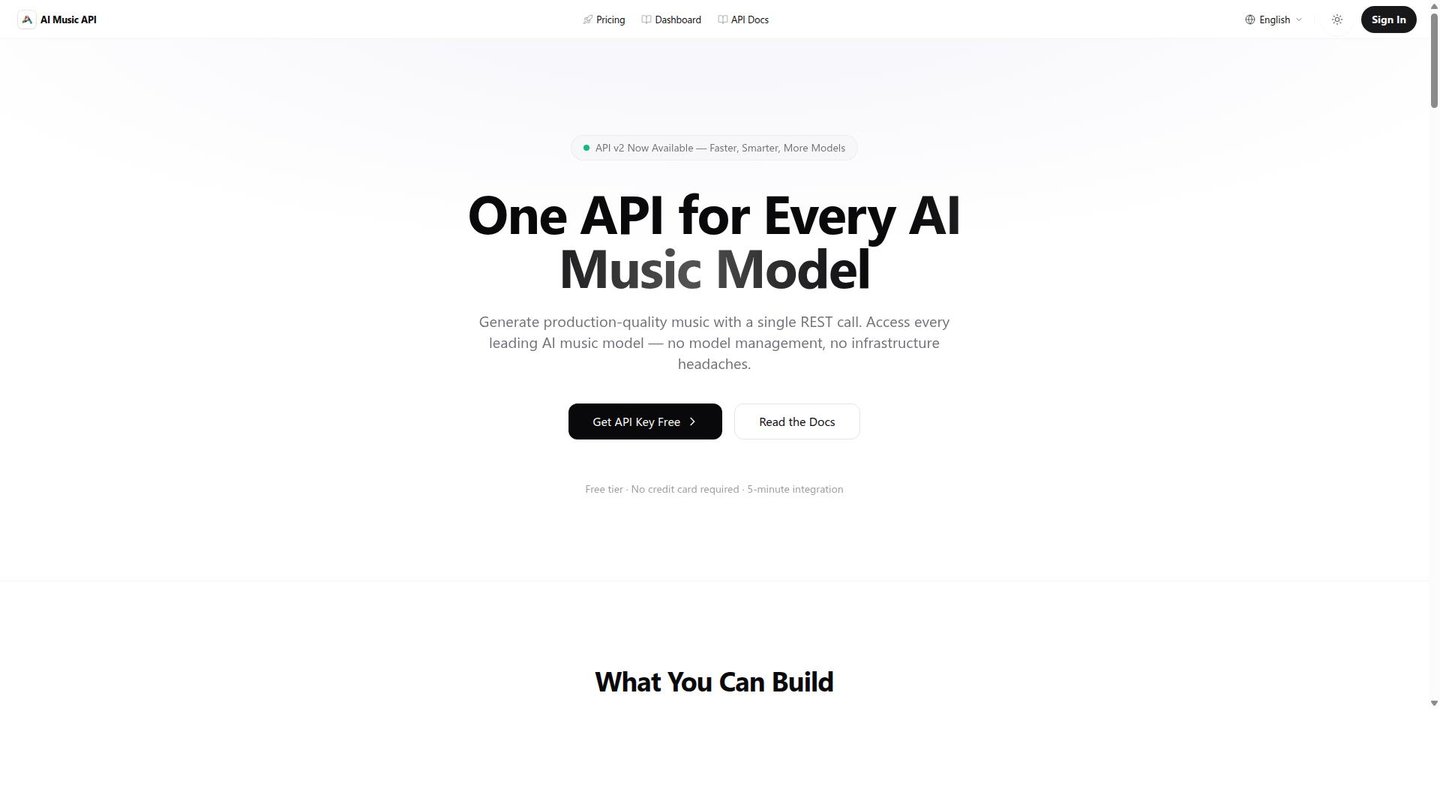
AI Music API converts text prompts and style parameters into rendered audio tracks without requiring a music model stack to be built or hosted in-house. Developers send genre, mood, tempo, and instrument settings to a REST endpoint and receive audio back, drawing on multiple underlying models such as Stable Audio and MusicGen. Credits meter usage, with roughly 7-20 credits spent per music render, so cost scales with generation volume rather than a flat seat fee. Python and JavaScript SDKs wrap the calls, letting one endpoint plug into a game engine or app backend.
Main Features
Unified REST API
AI Music API exposes one REST endpoint that routes requests to multiple underlying music models instead of requiring separate integrations for each provider. Requests use standard JSON payloads, so a single client library covers every supported model. This removes the need to maintain separate SDKs or authentication schemes per model vendor.
Multi-Model Access
The API gives access to 58 image, 51 video, and multiple music models, including Stable Audio and MusicGen, under one account. Switching models means changing a parameter in the request, not renegotiating a separate contract. Teams testing which model fits a genre or use case can compare outputs without new integrations.
Full Audio Control
Users set genre, mood, tempo, and instrumentation directly in the generation request rather than relying on a single fixed style. This exposes creative control at the API level instead of through a separate editing tool. Game and app developers can script variation programmatically rather than manually adjusting each track.
Enterprise-Grade Security
AI Music API is SOC 2 compliant and uses end-to-end encryption for API traffic. This applies to every plan tier, not just Enterprise, so smaller integrations inherit the same encryption baseline as production deployments. Software engineers building customer-facing apps get a documented security posture without a separate compliance negotiation.
Use Cases
-
Dynamic Soundtrack Generation
Game developers use AI Music API to generate soundtracks that adapt to gameplay scenarios and player actions in real time. Full Audio Control lets tempo and mood shift with prompt parameters. This removes the need for pre-recorded music libraries.
-
Music App Development
App developers integrate AI Music API so end users create original tracks from text prompts and style controls inside a consumer app. The Unified REST API and Multi-Model Access handle the generation backend. Developers avoid hosting or training a music model themselves.
-
Rapid Content Prototyping
Content creators use AI Music API for fast prototyping of royalty-free tracks for videos, podcasts, and social clips. Credit-based pricing lets small batches be generated without a subscription commitment. Iteration on mood or genre happens through prompt changes rather than re-recording.
Best For / Not For
AI Music API is built for developers who need programmatic access to music generation rather than a standalone desktop tool.
AI Music API fits Game Developers building adaptive soundtracks, App Developers shipping music-creation features inside consumer apps, and Music Producers mixing tracks across genres like pop, jazz, and ambient through prompt controls. Software Engineers deploying production-scale audio apps also gain from the documented SOC 2 encryption baseline.
AI Music API publishes no customer logos, funding disclosures, or third-party compliance audits beyond its stated SOC 2 claim, so buyers who require verified enterprise trust signals before procurement should look elsewhere.
Pricing
AI Music API offers a free tier for prototyping, then paid plans starting at $10 per user/month, billed monthly, for 1,000 credits, scaling up to Max at $50 per user/month for 5,000 credits.
| Plan | Price | Included |
|---|---|---|
| Free | Free | Generous free tier for prototyping and testing |
| Basic | $10 / user/month, billed monthly | 1,000 credits/month |
| Pro | $20 / user/month, billed monthly | 2,000 credits/month |
| Max | $50 / user/month, billed monthly | 5,000 credits/month |
Credit costs vary by model and render length, roughly 7-20 credits per music render, and requests pause once a balance hits zero until a top-up or upgrade is applied. Pay-as-you-go credits never expire, unlike the monthly subscription allocations, which reset each billing cycle.
Pricing checked 2026-09-18.
Quick Comparison
VideoAny is AI Music API’s main alternative for teams generating combined video and audio content in one workflow. VideoAny centers its pipeline on video generation with audio layered in as a supporting track. AI Music API instead offers Full Audio Control over genre, mood, tempo, and instruments through a dedicated music-only endpoint. Choose VideoAny if the priority is generating video with background audio attached. Choose AI Music API if the priority is a standalone, credit-metered music generation API for an existing app or game.
Verdict
AI Music API generates adaptive game audio and app-embedded tracks starting at $10/month for 1,000 credits, backed by SOC 2 encryption across every tier. It suits developers needing a programmatic music API rather than a desktop composing tool, with credit-based pricing scaling from prototypes to production.